In This Article
There’s a particular kind of despair that comes from standing in the bathroom aisle, squinting at ingredient lists, trying to decode whether “fragrance” means lavender oil or a cocktail of synthetic irritants that’ll have your skin screaming by bedtime. If you’re shopping for a honey soap bar for eczema, you already know this ritual. You’ve probably tried the £2 supermarket bar that smelled lovely and left your forearms looking like sandpaper. You’ve read forum threads at 1am, half-convinced that honey is either a miracle or a myth dreamed up by wellness bloggers with nothing better to sell.
Here’s the more grounded truth: honey isn’t magic, but it isn’t nonsense either. Raw honey and its hive cousins — beeswax and propolis — carry genuine, researched antibacterial and moisture-retaining properties, and the NHS confirms that emollients and daily moisturising are central to managing eczema symptoms, which is exactly the terrain honey-based soaps are built for. This guide walks through seven real, buyable bars — spanning budget beeswax blends to premium propolis formulas — with honest analysis of what each one actually does for dry, itchy, eczema-prone skin, and what it won’t.
Quick Comparison Table
If you’re short on time and just want the shape of the market, here’s the fast version.
| Product | Type | Price Range | Best For |
|---|---|---|---|
| Eczema Honey Gentle Oatmeal & Lavender Soap Bar | Honey + oatmeal | £8-£12 | Daily all-rounder, families |
| Bee Haven Bodycare Goats Milk & Beeswax Honey Soap | Beeswax + goat’s milk | £5-£8 | Itchy flare-ups |
| Honey Bee Beautiful Raw Honey Sensitive Skin Soap | Raw honey, fragrance-free | £6-£9 | Face and body, minimal ingredients |
| Red Seal Propolis and Manuka Honey Soap Bar | Propolis + manuka honey | £3-£6 | Budget antibacterial pick |
| A Basket of Bees Honey & Beeswax Soap | Small-batch beeswax | £4-£7 | Hand-crafted, traceable sourcing |
| Madeleine Ritchie Manuka Honey Skincare Soap | Manuka honey + propolis | £12-£18 | Premium, stubborn patches |
| Odylique Organic Honey & Oat Soap Bar | Organic honey + oats | £6-£9 | Gentle exfoliation, organic certification |
Reading this table left to right, the pattern is worth noticing: cheaper doesn’t necessarily mean weaker, and pricier doesn’t automatically mean more effective for eczema specifically. Red Seal Propolis and Manuka Honey Soap Bar sits at the value end but still carries genuine antibacterial ingredients, while Madeleine Ritchie Manuka Honey Skincare Soap earns its premium position through a denser formula built specifically for problem skin rather than everyday use. If you’re buying for a child or for daily family use, weight the “Best For” column more heavily than the price column.
💬 Found a bar that looks right for you already? Jump straight to it in the comparison above — every click helps you skip the guesswork.
Top 7 Honey Soap Bars for Eczema: Expert Analysis
Choosing a soap when your skin is already inflamed feels like defusing something. One wrong ingredient — sodium lauryl sulfate, a heavy synthetic fragrance, a pH that’s miles off your skin’s natural 5.5 — and you’re back to square one, itchier than before. The seven bars below were chosen to cover the real range of what’s actually on shelves: honey-only formulas, beeswax blends, propolis-boosted bars, and organic options, at prices from pocket-money to proper treat.
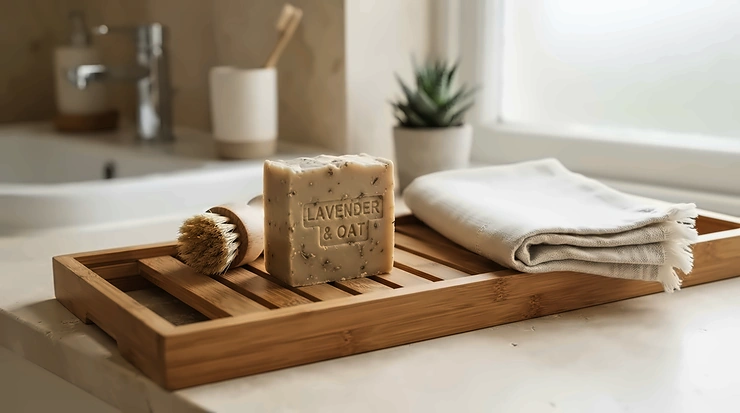
1. Eczema Honey Gentle Oatmeal & Lavender Soap Bar — best all-rounder for daily family washing
This one leans on a straightforward pairing: raw honey alongside grapeseed oil and colloidal oatmeal, with lavender for scent (a fragrance-free version also exists for anyone who reacts to essential oils). Grapeseed oil is a lightweight emollient, meaning it sits on the skin’s surface without clogging pores — genuinely useful for eczema-prone skin that’s often both dry and reactive at the same time. Colloidal oatmeal, meanwhile, is one of the few ingredients with a long clinical track record for calming itch, working by forming a thin protective film over broken skin barrier.
Based on the ingredient profile, this bar earns its “gentle enough for babies” claim reasonably well: no parabens, no sulfates, no phthalates. It’s a sound pick for parents managing a household where more than one person has sensitive skin, since the lavender variant offers a pleasant wash experience while the unscented sibling covers anyone who can’t tolerate essential oils at all.
Reviewers consistently report that the bar lathers less than a typical soap — which sounds like a downside until you realise low lather usually correlates with a gentler surfactant system, not a weaker clean. A recurring theme in aggregated feedback is that the bar melts faster than expected if left sitting in water, so a draining soap dish matters more here than with harder bars.
Pros:
- ✅ Fragrance-free variant available for essential-oil sensitivity
- ✅ Colloidal oatmeal genuinely soothes active itching
- ✅ Suitable across ages, from babies to adults
Cons:
- ❌ Softens quickly without a well-draining dish
- ❌ Lower lather may feel unfamiliar to some users
Expect this one in the around-£10 range for a standard bar. Given the multi-age suitability, it represents solid value for a household rather than a single user.
2. Bee Haven Bodycare Goats Milk & Beeswax Honey Soap — best for itchy flare-ups
Where the first bar plays it gentle and general, this one is built with a sharper focus: goat’s milk, beeswax, and honey combined specifically for eczema and psoriasis-prone skin. Goat’s milk brings naturally occurring fatty acids and lactic acid, a mild alpha-hydroxy acid that helps loosen the build-up of dead skin that often sits on top of eczema patches, while beeswax forms a breathable barrier layer over broken skin — different from petroleum-based barriers in that it lets the skin underneath still exchange moisture and air.
What most buyers overlook about this style of soap is that the “barrier” function of beeswax matters most during a flare, not during calm periods. On clear skin, a beeswax bar can feel almost too rich; on cracked, weeping patches, that same richness is protective. This is a soap to reach for specifically when things have gone downhill, not necessarily your everyday face wash.
Aggregated customer sentiment is notably consistent around this small UK brand: buyers repeatedly describe it as their “repurchase” product for eczema-prone skin, and several mention pairing it with a matching balm for night-time use. It’s worth noting this is a small-batch, handmade product, so batch-to-batch consistency in scent-free lots can vary slightly — a trade-off many buyers accept for the traceability of a small producer.
Pros:
- ✅ Fatty acids in goat’s milk support the skin barrier
- ✅ Beeswax creates a breathable protective layer
- ✅ Strong, repeat-purchase sentiment from eczema-prone reviewers
Cons:
- ❌ Can feel heavy on skin without active flare-ups
- ❌ Small-batch production means occasional stock gaps
Priced in the £5-£8 range, it’s one of the more affordable specialist options here, making it easy to keep a spare bar on hand for the next flare-up.
3. Honey Bee Beautiful Raw Honey Sensitive Skin Soap — best fragrance-free minimalist bar
This is deliberately the simplest bar on the list, and that’s the entire point. The ingredient list runs to a handful of saponified oils plus honey — no essential oils, no milks, no added fragrance of any kind. For eczema-prone skin, minimalism is itself a strategy: fewer ingredients mean fewer potential triggers, which matters enormously if you’re still in the process of patch-testing your way to a safe routine.
What the spec sheet won’t tell you, but reviewers note, is that this bar produces a notably creamy lather despite having no glycerin-boosting additives — a function of the specific oil blend used in the base recipe. That’s a meaningful detail for anyone whose skin reacts badly to stripping, foam-heavy soaps; a creamy lather generally signals a gentler surfactant profile.
One aggregated review theme stands out here: multiple users specifically mention using it on both face and body, which isn’t something you’d typically recommend with a fragranced bar. The honest caveat is that “fragrance-free” doesn’t mean “hypoallergenic” — raw honey itself is a rare but real allergen for some people, so anyone with a known bee-product allergy should skip this entire category of soap regardless of brand.
Pros:
- ✅ Minimal ingredient list reduces trigger risk
- ✅ Creamy, non-stripping lather from oil-only base
- ✅ Gentle enough for face and body use
Cons:
- ❌ Not suitable for anyone with a bee-product allergy
- ❌ No scented variant if you prefer fragranced soap
You’re looking at roughly £6-£9 for this one, which sits comfortably mid-table given its narrow, purpose-built formula.
4. Red Seal Propolis and Manuka Honey Soap Bar — best budget antibacterial pick
Red Seal is a long-running New Zealand brand, and this bar pairs propolis — the resin-like substance bees use to seal and disinfect their hives — with manuka honey. Propolis has a genuinely interesting antimicrobial profile of its own, separate from honey’s, and combining the two gives this bar a stronger antibacterial lean than a plain honey soap. That matters specifically for eczema because broken, scratched skin is more vulnerable to secondary bacterial infection, a complication dermatology guidance treats as a real risk rather than a hypothetical one.
Based on the formulation, this is a vegetable-based soap with no animal fats and no harsh chemical additives, which keeps it accessible for a broad range of skin sensitivities despite its active, functional ingredient list. The trade-off for the low price point is a relatively basic bar shape and packaging — this isn’t a soap bought for the unboxing experience.
A common thread in aggregated feedback is that this bar is praised for troubled, acne-adjacent skin as much as for eczema, which tracks with propolis’s broad-spectrum antibacterial reputation rather than being specific to any one condition. Reviewers also flag that the scent is distinctly “honey-forward” rather than neutral, which is either a plus or a minus depending on your fragrance tolerance.
Pros:
- ✅ Propolis adds a genuine antibacterial layer beyond honey alone
- ✅ Vegetable-based formula, no animal fats
- ✅ One of the most affordable specialist bars available
Cons:
- ❌ Noticeably honey-scented, unsuitable for fragrance-avoidant users
- ❌ Basic packaging compared with premium alternatives
At around £3-£6, this is genuinely one of the cheapest ways to try a propolis-honey combination, making it a sensible first step before committing to pricier options.
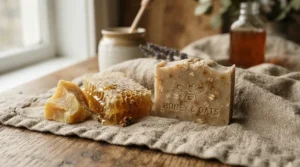
5. A Basket of Bees Honey & Beeswax Soap — best small-batch, traceable beeswax bar
This is a family-run operation based in Basingstoke, Hampshire, using honey and beeswax sourced from their own hives — about as traceable as a honey soap bar gets. The pitch here isn’t just “natural,” it’s specifically that beeswax encourages healthy skin cell turnover while forming a light, water-resistant layer that helps protect the skin’s own natural oils from washing away entirely.
Here’s what most buyers overlook about locally sourced beeswax soap: because the beeswax content and honey ratio can vary slightly by batch — a function of what the hives actually produced that season — texture and scent intensity may shift subtly between purchases. For most users this is a non-issue, but if you’re the type who wants pharmaceutical-grade consistency, a mass-produced bar will suit you better.
Because this is a small independent producer rather than a large listed brand, the volume of aggregated online reviews is naturally smaller than for the bigger names on this list; what feedback exists tends to focus on the soap’s mildness and the appeal of knowing exactly where the ingredients came from, though buyers should weigh this against the more limited sample size compared with high-volume competitors.
Pros:
- ✅ Fully traceable, small-scale UK sourcing
- ✅ Beeswax supports skin barrier protection
- ✅ Appeals strongly to buyers wanting minimal supply chains
Cons:
- ❌ Batch variation in scent and texture
- ❌ Smaller review pool than major brands
Priced around £4-£7, it slots into the same budget-to-mid bracket as the Red Seal bar, but with a very different story behind the honey.
6. Madeleine Ritchie Manuka Honey Skincare Soap — best premium bar for stubborn patches
This New Zealand-made bar is the most clinically-styled option on the list, built specifically around certified active manuka honey alongside propolis, evening primrose oil, and calendula oil — a combination chosen for sensitive skin conditions including eczema, dermatitis, and psoriasis rather than general daily washing. Active manuka honey is graded for its antibacterial potency, and the inclusion of evening primrose oil (rich in gamma-linolenic acid, a fatty acid linked to skin barrier support) pushes this formula further toward “treatment” territory than “cleanser.”
On paper, this means the bar is doing more simultaneous jobs than most others on this list: antibacterial defence from manuka and propolis, barrier support from evening primrose, and calming from calendula, a botanical long used for irritated skin. That density of active ingredients is exactly why it commands a premium price — you’re paying for concentration, not packaging.
The honest trade-off is that a formula this active isn’t necessarily the right daily-driver soap for someone with only mild, occasional dryness; it’s better matched to someone actively managing a diagnosed condition who wants a soap that pulls its weight therapeutically. Reviewers in this category tend to be specifically seeking out manuka-grade products, so expect a smaller but more targeted community of feedback than for mass-market bars.
Pros:
- ✅ Multi-active formula: manuka honey, propolis, evening primrose, calendula
- ✅ Fragrance-free, purpose-built for sensitive skin conditions
- ✅ Sourced from a country with strong manuka certification standards
Cons:
- ❌ Premium price relative to bars on this list
- ❌ May be more formula than someone with mild dryness needs
Expect to pay in the £12-£18 range — noticeably more than the others, but arguably justified by the specificity of the ingredient list for eczema-prone skin.
7. Odylique Organic Honey & Oat Soap Bar — best organic, gently exfoliating bar
Odylique’s bar combines organic extra virgin olive oil, organic coconut oil, oats, and honey in a genuinely short, organic-certified ingredient list. Oats here do double duty as both a mild physical exfoliant and a skin-soother — not dissimilar in function to the colloidal oatmeal in the Eczema Honey bar, but delivered as whole ground oats rather than the colloidal (finely milled and suspended) form.
What’s genuinely useful about this bar is the organic olive oil base: saponified olive oil soaps are naturally richer in the glycerine by-product of soap-making, which stays in the bar rather than being extracted out (as happens in many commercial soap manufacturing processes). That retained glycerine is a humectant, meaning it actively draws moisture into the skin during washing rather than just cleansing and leaving.
Reviewers consistently describe this bar as gentle enough for facial use, a detail worth flagging since not every soap on this list is recommended for the face — the physical exfoliation from ground oats means people with very reactive or broken skin should patch-test before using it there specifically, even though the overall formula is mild.
Pros:
- ✅ Organic-certified with a short, traceable ingredient list
- ✅ Retained glycerine boosts moisture during washing
- ✅ Gentle physical exfoliation from ground oats
Cons:
- ❌ Physical exfoliation may not suit very broken skin
- ❌ Premium-adjacent pricing for a 100g bar
At around £6-£9 for a 100g bar, it’s positioned as an everyday organic option rather than a specialist treatment bar, making it a sensible middle-ground pick.
Practical Usage Guide: Getting the Most From Your Honey Soap Bar
Buying the right bar solves maybe half the problem. How you actually use it does the rest of the work — and this is where most people quietly sabotage a perfectly good soap.
Start with water temperature. Hot water feels wonderful on itchy skin in the moment, but it strips natural oils faster than any soap ingredient, and using hot water can cause eczema flare-ups, which is why lukewarm water is the safer default. Keep showers and baths brief — five to ten minutes is the general guidance — and resist the urge to scrub. A honey soap bar for eczema is designed to work through mild lather contact, not friction.
Storage matters more than people expect. Honey and beeswax bars are naturally softer than synthetic detergent bars, and leaving them sitting in a pool of water will turn a £10 bar into a gloopy mess within a fortnight. A ridged, self-draining soap dish extends bar life significantly — this alone is the single most common first-30-days mistake buyers make.
Timing your moisturiser is the other half of the equation. Dermatology guidance consistently points to applying emollient within three minutes of patting skin dry, while the skin is still slightly damp — this locks in the moisture from washing rather than letting it evaporate. A honey soap bar can start that hydration process, but it can’t finish the job alone; pair it with a fragrance-free moisturiser for the full routine to make sense.
For the first 30 days with a new bar, patch-test on a small area of forearm skin for 48 hours before using it on already-inflamed patches or the face. This single step catches the rare cases where honey, propolis, or a specific oil doesn’t agree with your skin, before you’ve committed a whole bar and a flare-up to the experiment.
Real-World Scenarios: Which Honey Soap Bar Suits You?
Abstract advice only gets you so far, so here are three genuinely common situations and how the products above map onto them.
The parent of a toddler with mild, occasional eczema patches needs something low-risk above all else — a bar the whole family can use without a second product cluttering the bathroom shelf. The Eczema Honey Gentle Oatmeal & Lavender Soap Bar, particularly the fragrance-free version, fits this brief: broad age suitability, no harsh sulfates, and a manageable price point for a product that’ll get used up quickly by a family of four.
The adult managing a genuine flare-up right now, with visibly cracked or weeping patches, needs something with real barrier and antibacterial function rather than a gentle everyday wash. This is where Bee Haven Bodycare Goats Milk & Beeswax Honey Soap or Madeleine Ritchie Manuka Honey Skincare Soap earn their keep — the beeswax barrier and the concentrated manuka-propolis formula respectively are built for exactly this scenario, not for maintenance on calm skin.
The budget-conscious student or first-time buyer who wants to test whether honey-based soap even helps their skin before committing to a premium option should start with Red Seal Propolis and Manuka Honey Soap Bar. It’s inexpensive enough to try without much financial risk, while still containing genuinely active propolis and manuka honey rather than a token honey scent.
Problem → Solution: Common Eczema Skin Issues, Solved
Problem: Skin feels tight and squeaky-clean right after washing. That “squeaky” sensation is actually a red flag, not a sign of cleanliness — it usually means the soap has stripped the skin’s natural oils entirely. Switch to a bar with retained glycerine, like the Odylique Organic Honey & Oat Soap Bar, and apply moisturiser within three minutes of drying.
Problem: A patch keeps getting more inflamed despite gentle washing. This is a sign to reduce active ingredient density temporarily, not increase it. Drop back to the simplest formula available — Honey Bee Beautiful Raw Honey Sensitive Skin Soap‘s short ingredient list minimises the number of variables while the flare settles.
Problem: Soap disappears within a week or two. Nearly always a storage issue rather than a product fault. Honey and beeswax bars soften faster than synthetic bars when left wet; a self-draining dish, used consistently, roughly doubles usable bar life.
Problem: Unsure whether it’s the soap or something else triggering flare-ups. Run a proper elimination test: use one fragrance-free bar exclusively for two weeks, keeping every other product in your routine unchanged, and track flare frequency in a notes app. This isolates the soap variable cleanly.
Problem: Worried about honey allergy but want to try this category anyway. Patch-test on the inner forearm for 48 hours before any full-body use, and if you have a known bee-sting or bee-product allergy, skip honey and propolis soaps entirely and look for oat- or shea-based alternatives instead.
How to Choose a Honey Soap Bar for Eczema
Picking the right bar comes down to a handful of concrete checks rather than guesswork:
- Check the fragrance status first. Fragrance-free beats “unscented” — unscented products sometimes contain masking fragrances that can still trigger reactions.
- Scan for sulfates. Sodium lauryl sulfate creates satisfying foam but is a known irritant for compromised skin barriers; avoid it where eczema is active.
- Match the active ingredient to your current skin state. Plain honey suits calm, maintenance-phase skin; propolis or manuka-boosted bars suit active flares needing antibacterial support.
- Look at the ingredient list length. Shorter generally means fewer potential triggers, which matters most during a patch-testing phase.
- Consider the format alongside your routine. A bar that softens quickly in a shared, humid bathroom needs a draining dish — factor that into your buying decision, not just the soap itself.
- Weigh price against usage frequency. A premium bar used sparingly on flare patches can be more cost-effective than a cheap bar used daily by a whole household.
- Verify allergy compatibility. Anyone with a diagnosed bee-product allergy should treat this entire category as off-limits, honey and propolis alike.
Beeswax Soap vs Plain Glycerin Soap for Eczema
These two categories get lumped together in casual conversation, but they behave quite differently on skin. Plain glycerin soap relies on glycerine’s humectant properties — it draws moisture from the air into the skin, which works well in humid conditions but can occasionally pull moisture out of very dry skin in low-humidity environments instead. Beeswax soap eczema formulas, by contrast, work through an occlusive rather than humectant mechanism: beeswax sits on the skin’s surface and physically slows water loss, functioning more like a light second skin than a moisture magnet.
For most people managing eczema day-to-day, glycerin-forward bars like the Odylique Organic Honey & Oat Soap Bar make sense as an everyday wash. But during an active flare, when the skin barrier is genuinely compromised and losing water rapidly, the occlusive protection of a beeswax formula like Bee Haven Bodycare Goats Milk & Beeswax Honey Soap or A Basket of Bees Honey & Beeswax Soap tends to offer more immediate relief. Neither approach is objectively superior — they’re solving slightly different problems, which is exactly why keeping one bar from each category on hand isn’t overkill; it’s practical.
Honey Propolis Soap: What Makes It Different
Propolis deserves its own explanation because it’s genuinely distinct from honey chemically, despite both coming from bees. Bees produce propolis from tree resins mixed with their own secretions, using it to seal cracks and disinfect the hive interior — which gives you a fairly good intuition for why it shows up in antibacterial skincare. Laboratory and clinical evidence shows that honey acts as a broad-spectrum antibacterial agent, with effects including stimulation of tissue growth and enhanced epithelialization, and propolis brings an additional, separate layer of antimicrobial compounds to the mix.
What this means practically for a honey propolis skin soap is a bar doing genuinely more than one job: honey’s moisture retention and gentle antibacterial action, plus propolis’s stronger, more targeted antimicrobial punch. That’s precisely why Red Seal Propolis and Manuka Honey Soap Bar and Madeleine Ritchie Manuka Honey Skincare Soap sit at opposite price points but share a common logic — both are betting on that combination doing real work against the bacterial colonisation that often accompanies scratched, broken eczema skin, rather than honey’s moisture benefits alone.
The reasonable caveat: soap contact time is brief, typically seconds rather than minutes, so a soap bar will never deliver the concentrated antibacterial dose of a leave-on medical-grade honey dressing used in wound care. Think of propolis-honey soap as a supportive daily habit, not a substitute for treating an infected patch that needs proper medical attention.
Why Natural Antibacterial Soap Matters for Eczema-Prone Skin
Natural antibacterial soap eczema searches usually come from one specific worry: that scratched, broken skin is more vulnerable to infection than intact skin, and that’s a reasonable concern rather than an overreaction. Eczema-prone skin frequently carries higher levels of certain bacteria than healthy skin, and scratching creates literal entry points through a barrier that’s already compromised.
This is where the antibacterial angle of honey-based soaps earns its place, separate from the moisturising conversation entirely. Clinical observations have documented honey’s wound healing properties for decades, and while a soap bar isn’t a wound dressing, the same underlying antibacterial mechanisms apply during the brief contact of washing. Reaching for a honey or propolis bar during a flare — rather than a stripped-back antibacterial gel packed with harsh synthetic agents — offers a gentler route to the same general goal: fewer opportunistic bacteria on already-stressed skin.
The practical takeaway: this benefit matters most during active flares with visibly broken skin, and matters considerably less on calm, intact skin, where a simple, fragrance-free moisturising bar does the job perfectly well without needing the antibacterial extras.
Raw Honey Skin Healing Soap: Separating Fact From Marketing
Marketing copy loves the word “healing,” and it’s worth being precise about what that actually means here. A raw honey skin healing soap genuinely can support the skin’s own repair processes — but the mechanism is supportive, not curative. Honey isn’t going to cure eczema, because eczema is a chronic, barrier-related condition with genetic and environmental drivers that no topical product resolves outright.
What raw honey specifically brings, compared with processed or “honey-flavoured” formulations, is retained enzymatic activity and a broader spectrum of trace compounds that heat processing tends to degrade. This is the reasoning behind bars like Honey Bee Beautiful Raw Honey Sensitive Skin Soap leaning specifically on the word “raw” in their branding rather than just “honey” — it’s a genuine formulation choice, not just marketing flourish, assuming the brand is transparent about sourcing (which, to their credit, this one is).
The honest framing: raw honey soap is a legitimate supportive tool within a broader eczema management routine that should still include proper moisturising, trigger avoidance, and — for moderate-to-severe cases — the medical treatments a GP or dermatologist would prescribe. Treat “healing” as “supportive,” and expectations stay realistic.
Common Mistakes When Buying Honey Soap for Eczema
The first mistake is treating “natural” as automatically synonymous with “safe for my skin.” Honey is a real, if uncommon, allergen, and essential oils marketed as natural additions can be just as irritating as synthetic fragrance for reactive skin — natural doesn’t bypass the patch-test step.
The second is buying based on scent appeal alone. A gorgeously fragranced honey bar might smell like a spa day, but if that fragrance comes from added essential oils rather than the honey itself, it’s introducing exactly the kind of variable that makes eczema harder to manage and troubleshoot.
The third is assuming more active ingredients automatically means better results. Piling manuka honey, propolis, several oils, and botanical extracts into one bar sounds impressive, but for skin currently calm and well-managed, that density can sometimes overwhelm rather than help — simpler is often the smarter starting point.
The fourth, and perhaps most common, is giving up on a new bar after just a few washes. Skin barrier changes take time to show — most dermatology guidance points to a minimum of two to four weeks before judging whether a new skincare product is working, not two to four days.
Long-Term Cost & Maintenance
A bar priced around £8 that lasts six weeks with proper storage works out to roughly £0.19 a day — genuinely comparable to, or cheaper than, many liquid body washes once you account for how quickly bottled products get used up. The maths shifts considerably based on storage habits, though: a bar left sitting in standing water can lose a third of its lifespan, effectively raising the real cost-per-wash by 30-40% without the buyer noticing why.
Buying in multi-packs, where available, typically shaves 10-15% off the per-bar price compared with single purchases, and makes sense once you’ve confirmed a particular bar suits your skin through initial patch-testing. For premium options like Madeleine Ritchie Manuka Honey Skincare Soap, a sensible long-term approach is reserving the bar for flare periods specifically, rotating in a cheaper daily-maintenance bar like Red Seal Propolis and Manuka Honey Soap Bar the rest of the time — this stretches the premium bar’s lifespan considerably while still keeping it on hand for when it’s genuinely needed.
Safety, Regulations & Patch-Testing Guide
Every cosmetic product legally sold in the UK — soap bars included — falls under formal safety oversight. Under UK cosmetics regulation, a product made available on the market must be safe for human health under normal or reasonably foreseeable use, and a cosmetic product cannot be placed on the market without a responsible person established in the United Kingdom who is accountable for that safety. This applies equally to a large listed brand and a small-batch producer like A Basket of Bees Honey & Beeswax Soap — the regulatory bar doesn’t drop just because the operation is small.
Practically, this means genuine UK and EU-compliant soap bars will carry clear ingredient listings (INCI names), a responsible person’s contact details somewhere on the packaging or product page, and accurate claims that don’t overstate what the product can do. If a listing makes bold medical claims — “cures eczema,” for instance — treat that as a red flag rather than reassurance; legitimate honey soap brands describe supportive, soothing benefits, not cures.
On patch-testing specifically: apply a small amount of lathered soap to the inner forearm, leave to dry without rinsing for 48 hours, and watch for redness, swelling, or itching beyond the application site. The best hand soaps for eczema are gentle and deeply moisturising, and that same gentleness principle should guide every product choice on this list — if a bar stings, tightens, or reddens skin on first contact, that’s information worth acting on rather than pushing through.
FAQ
❓ Is honey good for eczema-prone skin?
❓ Can a honey soap bar replace my eczema cream?
❓ Are beeswax soaps safe for children with eczema?
❓ Why does my honey soap bar melt so quickly?
❓ Can I use a honey soap bar on my face if I have eczema?
Conclusion
Choosing a honey soap bar for eczema isn’t really about finding one perfect miracle bar — it’s about matching the right formula to where your skin actually is right now. A budget propolis bar like Red Seal Propolis and Manuka Honey Soap Bar earns its place for everyday antibacterial support, while a concentrated formula like Madeleine Ritchie Manuka Honey Skincare Soap makes more sense reserved for active flares. Somewhere in between sit gentler, simpler bars — Honey Bee Beautiful Raw Honey Sensitive Skin Soap and Odylique Organic Honey & Oat Soap Bar among them — that work well as steady, low-risk daily companions.
What ties all seven together is honest, researched ingredient logic rather than empty “natural” marketing: real honey, real beeswax, real propolis, each doing a specific, explainable job. Pair whichever bar you choose with lukewarm water, prompt moisturising, and a bit of patience — skin barrier improvements take weeks, not days — and you’ve got a genuinely sound foundation for managing eczema-prone skin day to day.
Recommended for You
- Manuka Honey Soap Bar: 7 Best Picks Worth Buying (2026)
- Honey Soap Bar: 7 Best Natural Picks for Glowing Skin (2026)
- Goat Milk Soap Gift Set: 7 Best UK Picks for 2026 (Loved!)
Disclaimer: This article contains affiliate links. As an Amazon Associate, I earn from qualifying purchases. If you purchase products through these links, we may earn a small commission at no additional cost to you.
✨ Found this helpful? Share it with your friends! 💬🤗
