In This Article
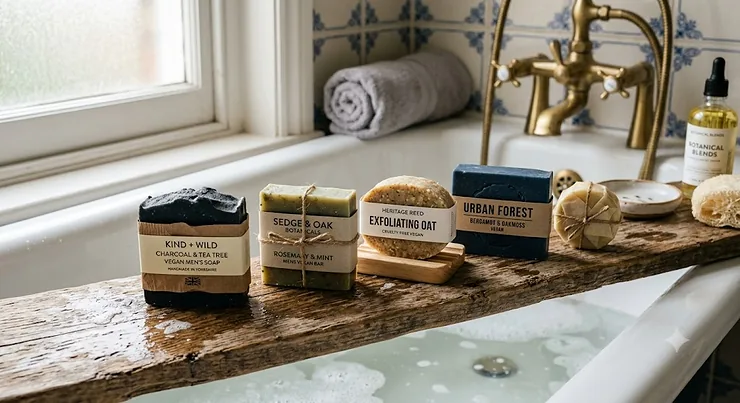
Here’s a confession most blokes won’t make out loud: the soap sitting on your shower shelf right now was probably never designed with your skin in mind. It’s just “soap” — mass-produced, tallow-adjacent, and about as considered as a free hotel toiletry. A genuinely good vegan soap bar for men changes that equation, because a plant-based formula means no animal fats, no rendered by-products, and — in most cases — a shorter, more honest ingredients list.
So, what is a vegan soap bar for men? It’s a bar cleanser made entirely without animal-derived ingredients (no tallow, lanolin, honey or milk derivatives) or animal testing, formulated with skin, scent and performance suited to typical male grooming habits — oilier T-zones, coarser body hair, and a general allergy to eleven-step routines.
This guide cuts through the marketing fluff. We’ve dug into real specs, genuine aggregated review sentiment, and the ingredient panels that most listings conveniently bury below the fold, so you can pick a bar based on what it’ll actually do in your shower, not what the packaging promises. Whether you’re chasing a plant based men’s soap bar for sensitive skin, hunting down a proper vegan activated charcoal soap men can rely on for oily patches, or you just want something that smells like a forest rather than a nightclub, we’ve got seven real, currently available bars broken down below — budget, mid-range and a couple of properly premium picks. According to the Vegan Trademark standards, a genuinely vegan product must involve no animal-derived ingredients or by-products anywhere in its manufacture — a bar worth knowing before you trust any label.
Quick Comparison Table
| Product | Best For | Key Ingredient | Price Range |
|---|---|---|---|
| Friendly Soap Charcoal Detox Bar | Budget-conscious buyers | Activated charcoal, rosemary & lime | Under £5 |
| Faith In Nature Blue Cedar Bar | Sensitive, all-round skin | Organic green tea, cedar | Around £2-£4 |
| Bulldog Skincare Original Bar Soap | Grooming beginners | Aloe vera, camelina oil | Around £3-£5 |
| Bulldog Skincare Oil Control Bar Soap | Oily/acne-prone skin | Charcoal, witch hazel | Around £3-£5 |
| Dr. Bronner’s Eucalyptus Pure-Castile Bar | Multi-use, travel/gym | Organic eucalyptus, hemp oil | £5-£8 range |
| Battle Green Charcoal Soap Slice | Small-batch ethical buyers | Charcoal, lavender, tea tree | £5-£7 range |
| Thistle Soapery Charcoal & Tea Tree Bar | Blemish-prone facial skin | Tea tree, tamanu oil | £6-£9 range |
Looking at this line-up, there’s a clear split between mainstream supermarket-accessible bars (Bulldog Skincare Original Bar Soap, Faith In Nature Blue Cedar Bar) and smaller-batch artisan bars (Battle Green Charcoal Soap Slice, Thistle Soapery Charcoal & Tea Tree Bar) that cost more per bar but often pack in a higher concentration of active ingredients. If you’re new to vegan grooming, start with a mainstream pick before committing to a niche brand’s full range — your skin (and your wallet) will thank you for the gentler introduction.
💬 Just one click — help others make better buying decisions too!😊
Top 7 Vegan Soap Bars for Men: Expert Analysis
Picking a genuinely vegan soap bar for men isn’t as simple as spotting a green leaf on the packaging — plenty of “natural-looking” bars still sneak in glycerin derived from animal fat or use undisclosed tallow blends. Every bar below has been checked against its published ingredient list and, where available, third-party vegan certification, so you’re not taking a brand’s word for it.
1. Friendly Soap Charcoal Detox Bar — best budget UK-handmade charcoal pick
Friendly Soap Charcoal Detox Bar opens with a genuinely clever formulation trick: activated charcoal paired with rosemary and lime essential oils, rather than the charcoal-alone approach most budget bars lean on. That pairing matters in practice — rosemary oil has mild astringent properties, so the bar doesn’t just absorb surface oil, it also tightens the feel of the skin afterwards, something a plain charcoal bar can’t claim.
Made in Nottingham with a sodium cocoate and sodium olivate base (coconut and olive oil soap, essentially), this is a genuinely simple formula — no synthetic fragrance, no SLS, no parabens. That simplicity is exactly why dermatology-minded buyers keep coming back to it: fewer ingredients generally means fewer things that can irritate reactive skin. Based on the spec comparison with the other budget bars here, this one earns its place through sheer ingredient transparency rather than flashy marketing.
Reviewers consistently report that the scent is subtle rather than overpowering — a common theme in aggregated feedback on plastic-free, small-batch soap makers, where “manly” fragrance intensity takes a back seat to genuine skin performance. A recurring point in user reviews is that the bar softens quickly if left sitting in water, so a draining soap dish is close to mandatory.
Pros:
- ✅ Fully plastic-free, palm oil-free and compostable packaging
- ✅ Short, transparent ingredients list suited to sensitive skin
- ✅ Handmade in Britain by an independently owned company
Cons:
- ❌ Softens faster than harder commercial bars without a soap dish
- ❌ Subtle scent may disappoint buyers wanting a strong “aftershave” smell
At under £5, this is genuinely one of the cheapest verified-vegan options on the market, and for anyone testing whether a plant based men’s soap bar suits their skin before committing to pricier ranges, it’s a low-risk starting point.

2. Faith In Nature Blue Cedar Hand & Body Soap Bar — best all-rounder for sensitive skin
Faith In Nature Blue Cedar Hand & Body Soap Bar has been around since 1974, and that longevity shows in the formulation — it’s been refined over five decades rather than rushed to market on a trend cycle. The bar blends organic green tea extract and vitamin E with a cedar and mountain herb scent profile, aiming squarely at the “smells like a man, feels gentle” niche.
What most buyers overlook about this brand is its dual certification: it’s both Vegan Society approved and Leaping Bunny cruelty-free certified, which is a genuinely higher bar than a simple “vegan friendly” claim on a label. That certified status also means the ingredients are audited annually, so the vegan claim doesn’t rely purely on brand goodwill.
Reviewers consistently note that the lather is noticeably creamier than most natural bars, likely down to the glycerine content retained during the cold-process method — commercial detergent bars often strip this out to speed up manufacturing. Aggregated feedback also flags the plastic-free cardboard wrap as a genuine plus among environmentally minded buyers, though a few reviewers mention the scent fades faster on skin than on the bar itself.
Pros:
- ✅ Vegan Society and Leaping Bunny dual-certified
- ✅ Creamy lather thanks to retained natural glycerine
- ✅ Widely stocked, so easy to repurchase locally
Cons:
- ❌ Cedar scent fades noticeably within a few hours on skin
- ❌ Standard 100g size means more frequent repurchasing than premium bars
In the mid-£2 to £4 range depending on pack size, this bar delivers the best value-to-certification ratio of anything on this list — a genuinely safe pick for anyone new to vegan men’s grooming soap.
3. Bulldog Skincare Original Bar Soap — best supermarket-shelf pick for grooming beginners
Bulldog Skincare Original Bar Soap deserves credit for something rarely mentioned: it was one of the first mainstream, purpose-built men’s grooming brands in the UK to go fully vegan and cruelty-free across its entire range, not just a token “eco” sub-line. The Original bar leans on aloe vera, camelina oil and green tea to keep the formula non-drying, which matters given how many “manly” soaps lean heavily on stripping surfactants for that squeaky-clean feel.
Here’s what the spec sheet won’t tell you, but reviewers note: this bar performs almost identically on face and body, which is a genuine convenience win for anyone who wants a single bar in the shower rather than a three-step routine. The RSPO-certified palm content and Forest Stewardship Council packaging show a brand thinking about supply chain, not just front-of-pack claims — worth flagging given how much scrutiny palm oil sourcing gets in the beauty industry, as Ethical Consumer’s soap guide makes clear.
A recurring theme in customer feedback is that this bar doesn’t leave the “tight” feeling associated with cheaper soaps — a direct result of the glycerine and aloe combination retaining moisture during the wash. Some reviewers do note the fragrance is fairly generic compared to niche competitors, which tracks with its mass-market positioning.
Pros:
- ✅ Widely available in UK supermarkets and pharmacies
- ✅ Suitable for face and body in one bar
- ✅ RSPO-certified sustainable palm sourcing
Cons:
- ❌ Fragrance reads as generic next to artisan competitors
- ❌ Formula not specifically targeted at any one skin concern
At around £3-£5, this is the easiest on-ramp into vegan men’s grooming soap for anyone who’s never actively sought out a plant-based bar before — no health-shop trip required.
4. Bulldog Skincare Oil Control Bar Soap — best for oily and acne-prone skin
Bulldog Skincare Oil Control Bar Soap takes the same brand DNA as the Original bar and retools it specifically for oily and blemish-prone skin, adding sustainably sourced Dorset charcoal alongside witch hazel, willow bark and juniper. That’s a genuinely well-thought-out combination: witch hazel provides gentle astringency, willow bark contributes a natural salicylic-acid-adjacent compound that helps with breakouts, and juniper calms visible redness.
Based on the spec comparison with plain charcoal bars, the addition of willow bark is the standout here — most vegan activated charcoal soap men can buy relies on charcoal alone to “detox” the skin, when in reality charcoal’s main job is mechanical absorption of surface oil, not treating underlying blemishes. Pairing it with willow bark gives this bar a genuine secondary mechanism, not just marketing language borrowed from skincare influencers.
Aggregated review sentiment consistently flags this as gentler than expected for a “charcoal” bar — a common worry with charcoal soaps is that they over-dry the skin, but reviewers report the witch hazel and glycerine content keep that in check. A recurring complaint, however, is that the charcoal can leave a faint grey residue on very pale bathroom surfaces if left directly on tile.
Pros:
- ✅ Willow bark adds a genuine anti-blemish mechanism beyond charcoal
- ✅ Witch hazel and glycerine prevent the over-drying charcoal bars are known for
- ✅ RSPO-certified and Cruelty Free International certified
Cons:
- ❌ Can leave faint grey marks on light bathroom surfaces
- ❌ Stronger scent profile than the Original bar, less versatile for sensitive noses
Priced similarly to the Original bar in the £3-£5 range, this is the pick for anyone whose main grooming complaint is an oily T-zone or the odd back breakout after a gym session.
5. Dr. Bronner’s Eucalyptus Pure-Castile Bar Soap — best multi-tasking bar for gym bags and travel
Dr. Bronner’s Eucalyptus Pure-Castile Bar Soap is arguably the most famous castile soap brand in the world, and the eucalyptus variant is a genuinely different beast to the charcoal-heavy bars above. Scented purely with organic eucalyptus oil rather than synthetic fragrance, it delivers that sharp, sinus-clearing hit that makes it a favourite for post-workout showers or foggy winter mornings.
Here’s what most buyers overlook: this bar is designed as an 18-in-1 product, meaning the same formula doubles as face wash, shampoo bar and even a laundry aid in a pinch. That versatility matters for anyone who travels light or wants to consolidate a gym bag down to one product. Fair Trade certified ingredients and organic hemp oil in the base give the lather a notably softer feel than the coconut-heavy bars elsewhere on this list, though eucalyptus oil can be strong for sensitive or broken skin — worth noting given that essential-oil-based products occasionally trigger contact dermatitis reactions in a minority of users.
Reviewers consistently praise the multi-use versatility and the genuinely potent eucalyptus scent, though a fair number mention it’s less moisturising on very dry skin than dedicated body bars, since castile soap formulas prioritise cleansing power over conditioning agents.
Pros:
- ✅ Certified organic, Fair Trade eucalyptus oil, no synthetic fragrance
- ✅ Doubles as shampoo, face wash and general-purpose soap
- ✅ Made from certified organic and non-GMO ingredients throughout
Cons:
- ❌ Can feel drying on already sensitive or broken skin
- ❌ Strong eucalyptus scent isn’t to everyone’s taste
Sitting in the £5-£8 range depending on pack size, this is the premium-adjacent pick here, and the per-use value improves considerably if you’re genuinely using it as a multi-purpose product rather than body soap alone.

6. Battle Green Charcoal Natural Soap Slice — best small-batch Welsh ethical pick
Battle Green Charcoal Natural Soap Slice is handmade in Wales in small batches, using a cold-process method that retains more of the naturally occurring glycerine than mass-manufactured soap. The formula layers avocado oil, olive oil, shea butter, coconut oil and castor oil around an upcycled charcoal powder base, scented with a lavender, tea tree, rosemary and peppermint blend that’s genuinely more complex than the single-note fragrances used by bigger brands.
What the spec sheet won’t tell you is how much that oil blend matters for longevity: castor oil in particular is known in soap-making circles for boosting lather stability, so this bar should hold its foam texture longer in the shower than simpler formulas. PETA-certified vegan and cruelty-free status backs up the brand’s own claims, which matters given how loosely “vegan friendly” gets applied across the wider industry.
Aggregated customer sentiment is enthusiastic, with reviewers frequently highlighting the refined, non-synthetic scent as the standout feature over cheaper charcoal bars — though as a small operation, availability can be less consistent than mainstream brands, and a few buyers note the minimally packaged bars arrive a little irregular in shape, which is really just proof they’re genuinely hand-cut rather than moulded.
Pros:
- ✅ PETA-certified vegan and cruelty-free
- ✅ Complex four-oil essential blend improves lather stability
- ✅ Compostable, minimal packaging from a small UK producer
Cons:
- ❌ Availability less consistent than mainstream brands
- ❌ Hand-cut bars vary slightly in shape and size
In the £5-£7 range, this bar rewards buyers who care as much about supporting small ethical manufacturers as they do about the soap itself — a genuine two-birds purchase.
7. Thistle Soapery Charcoal and Tea Tree Facial Soap — best dedicated face bar for blemish-prone skin
Thistle Soapery Charcoal and Tea Tree Facial Soap is the most face-focused product on this list, formulated specifically for oily, congested or blemish-prone skin rather than general body use. Unlike many charcoal soaps, it carries a higher level of nourishing oils, including tamanu oil — a lesser-known but well-regarded ingredient in acne-prone skincare circles for its skin-soothing properties, alongside tea tree, eucalyptus and peppermint essential oils for a genuinely fresh, cooling finish.
Based on the spec comparison with the other tea tree vegan soap bar options here, the tamanu oil inclusion is what elevates this beyond a standard charcoal-and-tea-tree combination — most competitors rely purely on tea tree’s antiseptic properties and risk over-drying facial skin in the process. Full CPSR compliance (the mandatory UK cosmetic safety assessment) and 100% vegan, cruelty-free status give this bar genuine regulatory credibility beyond marketing claims.
Reviewers consistently report improvements in redness and congestion with regular use, framed honestly as aggregated user experience rather than clinical proof — this is cosmetics, not medicine, and results will vary by skin type. A recurring theme is that buyers with genuinely dry or combination skin find it less drying than typical charcoal facial bars, though tea tree sensitivity is worth checking beforehand, since it’s a known allergenic trigger for a small subset of users.
Pros:
- ✅ Tamanu oil addition reduces the drying effect typical of charcoal bars
- ✅ Fully CPSR compliant for UK cosmetic safety standards
- ✅ Handmade in small batches with 100% vegan certification
Cons:
- ❌ Premium pricing compared to general body-soap options
- ❌ Tea tree and eucalyptus oils may irritate very sensitive facial skin
At £6-£9, this sits at the top of the price range here, but for anyone specifically hunting a vegan activated charcoal soap men can use on blemish-prone facial skin without the tightness that plagues cheaper bars, it earns its premium.
<p style=”text-align:center”><em><strong>💬 Just one click — help others make better buying decisions too!😊</strong></em></p>
Getting the Most From Your Vegan Soap Bar (Practical Usage Guide)
Buying the right bar is only half the job — how you use and store it determines whether it lasts three weeks or three days. First, always use a draining soap dish. Vegan bars, especially handmade cold-process ones like the Battle Green Charcoal Natural Soap Slice and Thistle Soapery Charcoal and Tea Tree Facial Soap, retain more natural glycerine than commercial detergent bars, which makes them noticeably softer and more prone to turning to mush if left sitting in standing water.
Second, resist the urge to scrub with a flannel or loofah every single day if you’re using a facial-focused bar like the Thistle Soapery slice — daily mechanical exfoliation on top of active tea tree and charcoal ingredients can tip skin from “clarified” into “irritated” within a fortnight. Alternate days if your skin runs sensitive.
Third, in the first 30 days of switching from a commercial detergent bar to a genuine plant-based one, expect a short adjustment period. Your skin’s natural oil production has likely been compensating for years of over-stripping surfactants, so a slight increase in oiliness for a week or two is normal and typically self-corrects. A common mistake here is switching back to the old product at the first sign of this, mistaking a temporary rebalancing period for the new bar “not working.”
Finally, store bars away from direct water spray between uses, and cut larger bars like the Dr. Bronner’s Eucalyptus Pure-Castile Bar Soap in half if you find full-size bars becoming an unwieldy, slippery hazard in a shared shower.
Who Should Buy Which Bar: Real-World Scenarios
Picture a first-year university student, budget stretched thin, sharing a bathroom with four flatmates. For him, the Friendly Soap Charcoal Detox Bar makes the most sense — genuinely cheap, plastic-free (so no bottle clutter on a shared shelf), and gentle enough that skin type barely matters.
Now picture a office worker in his thirties who spends most days at a desk but hits the gym three evenings a week and struggles with back breakouts after sweating. The Bulldog Skincare Oil Control Bar Soap is the more sensible pick here — the willow bark and charcoal combination directly targets the post-workout congestion he’s dealing with, and the price point suits a twice-weekly repurchase habit without feeling like a luxury.
Finally, consider someone in his fifties with generally dry, sensitive skin who’s recently gone vegan across his whole bathroom cabinet on ethical grounds, not just for skin reasons. The Faith In Nature Blue Cedar Hand & Body Soap Bar suits him well — the certified dual credentials tick the ethical box, while the retained glycerine content avoids the tightness that dry, mature skin reacts badly to.
How to Choose a Vegan Soap Bar for Men
- Check for third-party certification, not just the word “vegan” on the front. Look for the Vegan Society’s sunflower trademark or Leaping Bunny logo rather than trusting brand copy alone.
- Match the active ingredient to your actual skin concern. Charcoal suits oily or congested skin; retained-glycerine formulas suit dry or mature skin.
- Consider where you’ll use it. Multi-use bars like Dr. Bronner’s suit gym bags and travel; dedicated facial bars like Thistle Soapery’s suit a fixed bathroom routine.
- Factor in bar hardness and lifespan. Harder commercial bars last longer per wash than soft, glycerine-rich handmade bars.
- Read the full ingredients list, not just the marketing bullet points. Essential oils like tea tree and eucalyptus are natural but can still trigger sensitivity in a minority of users.
- Weigh cost-per-use, not just shelf price. A £8 bar that lasts six weeks can be cheaper long-term than a £3 bar replaced fortnightly.
- Check packaging claims against real sourcing standards, such as RSPO palm oil certification or FSC-certified cardboard, rather than vague “eco-friendly” language.
Vegan Men’s Grooming Soap vs Traditional Bar Soap and Body Wash
| Factor | Vegan Bar Soap | Traditional Bar Soap | Bottled Body Wash |
|---|---|---|---|
| Animal ingredients | None | Often contains tallow/glycerin blends | Varies, rarely disclosed clearly |
| Packaging waste | Minimal, often plastic-free | Moderate | High (plastic bottle) |
| Skin barrier impact | Generally gentler, retains glycerine | Can strip natural oils | Depends on surfactant strength |
| Best For | Ethically-minded, sensitive skin | Budget, no ethical preference | Convenience-focused showers |
The clearest takeaway from this table is that vegan men’s grooming soap and traditional bar soap can look nearly identical on a shelf, yet differ significantly in what happens to your skin barrier over weeks of use — retained glycerine in most vegan formulas is the deciding factor. Bottled body wash wins on convenience and lather volume but loses heavily on packaging waste, which matters increasingly to buyers making sustainability part of their grooming decision. If your priority is genuinely reducing bathroom plastic, a bar of any kind beats a bottle — but only a certified vegan bar guarantees no animal by-products crept into the formula.
✨ Don’t Miss These Exclusive Deals!
🔍 Take your bathroom shelf to the next level with these carefully selected picks. Click on any highlighted bar to check current pricing and availability. These plant-based bars will help you build a genuinely honest grooming routine your skin will thank you for!
A Plant Based Men’s Soap Bar for Every Skin Type
Not every plant based men’s soap bar suits every skin type, and pretending otherwise is exactly the kind of generic advice this guide is trying to avoid. Oily and combination skin generally responds best to charcoal-forward bars like the Bulldog Skincare Oil Control Bar Soap or Thistle Soapery Charcoal and Tea Tree Facial Soap, where mechanical oil absorption and mild astringency do genuine work.
Dry or mature skin, by contrast, benefits far more from glycerine-retentive formulas — the Faith In Nature Blue Cedar Hand & Body Soap Bar and Battle Green Charcoal Natural Soap Slice both fall into this camp, since cold-process soap-making naturally preserves more moisturising glycerine than commercial detergent bars.
Sensitive skin is trickier territory. Fragrance-heavy essential oil blends, however “natural,” can still provoke reactions — the NHS notes that contact dermatitis most commonly stems from everyday irritants including soaps and detergents, so anyone with a history of reactive skin should patch-test a small area before committing to full-body use of any new bar, vegan or otherwise.
Vegan Activated Charcoal Soap for Men: Does It Actually Work?
Vegan activated charcoal soap men buy in growing numbers rests on a genuinely simple mechanism: activated charcoal has an enormous surface area riddled with microscopic pores, which physically trap oil, dirt and some impurities as you lather and rinse. It’s not magic detoxification — it’s mechanical absorption, and it works best on surface-level oiliness rather than deep-set blemishes.
Across the three charcoal bars featured here — Bulldog Skincare Oil Control Bar Soap, Battle Green Charcoal Natural Soap Slice, and Thistle Soapery Charcoal and Tea Tree Facial Soap — the meaningful difference isn’t the charcoal itself but what’s blended alongside it. Willow bark, tamanu oil and a wider essential oil complex each change how the bar performs on different skin types, which is exactly the kind of nuance a plain product listing won’t spell out.
The honest verdict: charcoal soap genuinely helps manage surface oil and can visibly reduce shine within days, based on aggregated review sentiment across all three bars. It won’t cure cystic acne or replace a dermatologist-recommended routine for serious skin conditions — treat it as a solid daily maintenance tool, not a miracle fix.
Tea Tree vs Eucalyptus Vegan Soap: Which Scent Suits You?
A tea tree vegan soap bar and a eucalyptus vegan soap bar solve genuinely different problems, despite both smelling broadly “medicinal” to the uninitiated. Tea tree oil is prized primarily for its antiseptic, anti-bacterial properties, which is why it turns up so consistently in blemish-focused bars like Thistle Soapery Charcoal and Tea Tree Facial Soap — it’s doing active work against the bacteria linked to breakouts, not just providing scent.
Eucalyptus, by contrast, is chosen mostly for its sensory effect — that sharp, sinus-opening menthol-adjacent hit that makes Dr. Bronner’s Eucalyptus Pure-Castile Bar Soap such a popular post-workout or early-morning pick. It has some mild antimicrobial properties too, but its main job in a soap formula is waking you up, not treating your skin.
Both oils carry a small but genuine risk of skin sensitivity. Medical sources note tea tree oil in particular can trigger allergic contact dermatitis in a minority of users, especially at higher concentrations or on already-compromised skin — so if you’ve never used either before, a small patch test on the inner forearm is a sensible first step rather than diving straight into a full facial wash.
Common Mistakes When Buying Vegan Soap Bars
The single biggest mistake is trusting the word “natural” as a proxy for “vegan” — plenty of genuinely natural soaps still contain goat’s milk, honey or animal-derived glycerine, none of which show up unless you actually read the ingredients panel. A second common error is buying based on scent description alone; “charcoal detox” sounds appealing on every bar, but the supporting ingredients (willow bark versus plain charcoal, for instance) determine actual performance far more than the marketing copy suggests.
Buyers also frequently underestimate how much bar hardness affects value — a soft, glycerine-rich handmade bar that dissolves in ten days works out considerably more expensive per wash than a firmer commercial bar, even if the shelf price looks similar. Finally, plenty of shoppers skip patch-testing entirely, assuming “natural” automatically means “non-irritating” — as covered above, essential oils like tea tree and eucalyptus can and do cause reactions in sensitive individuals regardless of their plant-based origin.
Long-Term Cost and Maintenance
Thinking purely in shelf price misses the real economics of bar soap. A £3 Bulldog Skincare Original Bar Soap used daily by one person typically lasts three to four weeks, while a £7 Battle Green Charcoal Natural Soap Slice, being softer and more glycerine-rich, might only stretch to two and a half weeks under similar use.
| Product | Approx. Price | Typical Lifespan (Daily Use) | Rough Cost Per Week |
|---|---|---|---|
| Friendly Soap Charcoal Detox Bar | Under £5 | 3-4 weeks | Under £1.50 |
| Bulldog Skincare Original Bar Soap | £3-£5 range | 3-4 weeks | Around £1.20 |
| Battle Green Charcoal Natural Soap Slice | £5-£7 range | 2-3 weeks | Around £2.20 |
Run the numbers over a year and the gap narrows less than you’d expect between “budget” and “premium” bars, simply because harder commercial-style bars last noticeably longer per wash. That said, the small-batch and facial-focused bars — Thistle Soapery Charcoal and Tea Tree Facial Soap in particular — are typically used in smaller quantities on the face alone, which stretches their real-world lifespan further than the raw price-per-gram suggests. Maintenance-wise, keeping any bar on a well-draining dish, away from direct shower spray, is the single biggest lever for extending its life regardless of brand.
Safety, Regulations and Compliance Guide
Every cosmetic bar soap sold legally in the UK, vegan or otherwise, must comply with UK cosmetics regulation, which requires a Cosmetic Product Safety Report (CPSR) confirming the formula has been assessed as safe by a qualified professional before it reaches shelves. Thistle Soapery Charcoal and Tea Tree Facial Soap explicitly advertises full CPSR compliance, which is worth looking for specifically on smaller, independent brands where consumers sometimes assume less rigorous oversight than larger manufacturers.
On the vegan side specifically, “vegan friendly” as marketing language carries no legal definition in the UK, which is precisely why third-party certification matters. The Vegan Society’s trademark process independently audits a product’s full ingredient and manufacturing chain, rather than relying on a brand’s self-declaration — a meaningfully higher bar than a soap simply stating “no animal ingredients” on its own packaging.
For anyone with a history of reactive or eczema-prone skin, the NHS advises using emollient-based soap substitutes rather than standard foaming bars, since everyday soaps can dry out and aggravate already-compromised skin barriers — worth flagging honestly here, since even the gentlest vegan bar is still, chemically, a soap rather than a medicated emollient.

FAQ
❓ Is vegan soap better for men's skin than regular soap?
❓ Can vegan soap help with body odour?
❓ Is charcoal soap safe to use every day?
❓ Do vegan soap bars last as long as regular bars?
❓ Are all 'natural' soap bars automatically vegan?
Conclusion
Choosing the right vegan soap bar for men really comes down to matching formula to actual skin need, not chasing the most dramatic-sounding ingredient on the label. If budget and simplicity matter most, the Friendly Soap Charcoal Detox Bar and Bulldog Skincare Original Bar Soap are sensible, low-risk starting points. If oil control or blemishes are your genuine concern, the Bulldog Skincare Oil Control Bar Soap and Thistle Soapery Charcoal and Tea Tree Facial Soap bring more targeted ingredients to the job. And if you want a single bar that earns its keep across gym bag, shower and even shampoo duty, Dr. Bronner’s Eucalyptus Pure-Castile Bar Soap is hard to beat on sheer versatility.
Whichever you choose, look past the word “vegan” on the packaging and check for genuine third-party certification, a transparent ingredients list, and — where relevant — CPSR compliance. That’s what separates a bar making an honest claim from one simply riding a trend. Prices and stock levels change regularly, so always check current pricing directly before buying, and patch-test anything containing essential oils if your skin has a history of sensitivity.
Recommended for You
- Vegan Soap Bar For Dry Skin: 7 Genuinely Nourishing Picks (2026)
- Vegan Soap Bar UK 2026: 7 Genuinely Cruelty-Free Picks Worth Buying
- Organic Soap Bar Gift Set: 7 Best Picks for 2026 UK Gifting
Disclaimer: This article contains affiliate links. As an Amazon Associate, I earn from qualifying purchases. If you purchase products through these links, we may earn a small commission at no additional cost to you.
✨ Found this helpful? Share it with your friends! 💬🤗
