In This Article
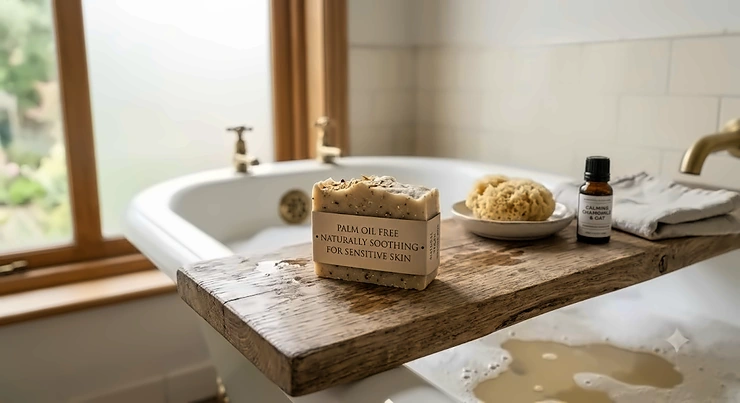
There’s a particular kind of frustration that comes with standing in the shower, watching a “gentle” bar of soap leave your forearms looking like you’ve been stung by nettles. If that’s you, you’ve probably already suspected the culprit isn’t soap in general — it’s what’s actually inside it. Palm oil free soap for sensitive skin has become the go-to search for a reason: sodium palmate (palm oil’s soap-making alias) is a common trigger for redness, tightness and flare-ups in people whose skin barrier is already working overtime.
This guide skips the marketing fluff and gets into the actual formulations. We’ve dug through real ingredient lists, aggregated genuine customer feedback, and lined up seven bars that range from pocket-money-friendly to properly indulgent, so you can match a soap to your skin rather than your skin to whatever was on the shelf. Whether you’re hunting for something to calm eczema, a bar built almost entirely from olive oil, or a coconut oil soap bar with a bit more lather, there’s a logical pick ahead.
We’ll also cover the practical stuff nobody puts on the label — how to actually patch-test a new bar, what “sodium olivate” and “sodium cocoate” mean in plain English, and why some soaps marketed as “natural” still sneak palm derivatives in through the back door. By the end, you’ll know exactly what to look for on an ingredients panel, and which of these seven bars deserves a spot in your bathroom.
Quick Comparison Table
| Product | Best For | Key Oils | Price Range |
|---|---|---|---|
| Little Soap Company Pure Organic Bar | Fragrance-free sensitive skin | Olive, coconut, shea | around £4-£5 |
| Friendly Soap Lavender & Geranium | Budget-conscious buyers | Coconut, olive, shea | under £3 |
| Save Our Seas Handmade Herbal Soap | Eco-conscious, multi-oil blend | Shea, olive, coconut, jojoba, almond | £6-£8 range |
| HERBOGANIC Castor Oil Herbal Soap | Extra-dry, flaky patches | Castor oil-forward blend | mid-£5s |
Even a quick scan tells a story: none of these leans on palm oil, but each one solves a slightly different problem. The Little Soap Company Pure Organic Bar wins on simplicity and certification, which matters if you’re patch-testing for allergens one ingredient at a time. Budget shoppers gravitate toward the Friendly Soap Lavender & Geranium bar because UK manufacturing keeps shipping miles (and cost) down, while the Save Our Seas Handmade Herbal Soap justifies its higher price with a five-oil blend that reads more like a facial oil recipe than a bathroom staple.
💬 Found a bar that looks promising already? Bookmark this page and compare it against the full breakdown below before you commit.
Top 7 Palm Oil Free Soaps for Sensitive Skin: Expert Analysis
1. Little Soap Company Pure Organic Bar Soap — organic and fragrance-free for reactive skin
The standout here is the ingredient count: olive oil, coconut oil, shea butter, water, and not much else. On paper, that short list matters more than it sounds — every additional ingredient is another possible trigger for someone with reactive skin, so a bar that’s essentially three oils and lye is about as low-risk as soap gets. The organic certification also means the underlying olive and coconut oils are grown without the pesticide residues that occasionally show up in cheaper commodity oils.
This bar is aimed squarely at people who’ve already been burned (sometimes literally) by scented “natural” soaps that still managed to sting. Based on the ingredient profile, it’s a strong fit for anyone doing an elimination-style skincare routine, or parents choosing a first soap for a child with reactive skin. Reviewers consistently report that the bar feels notably less drying than supermarket alternatives, with several long-term users specifically mentioning it as one of the few bars that doesn’t leave a tight, papery feeling after washing.
Pros:
- ✅ Certified organic, short ingredient list
- ✅ Genuinely fragrance-free, not just “unscented” masking
- ✅ UK-made with plastic-free packaging
Cons:
- ❌ Plainer scent profile won’t appeal to fragrance lovers
- ❌ Softer bar tends to wear down faster if left sitting in water
Priced in the mid-£4 range, this sits firmly in “worth the extra pound over a supermarket bar” territory — especially if a flare-up costs you more in moisturiser and misery than the soap itself.
2. Friendly Soap Lavender & Geranium Bar — best budget-friendly UK-made bar
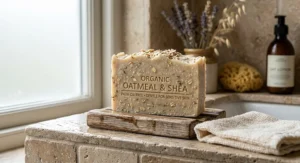
What most buyers overlook about this model is that “budget” and “basic” aren’t the same thing here. The bar is built from coconut oil, olive oil and shea butter, with lavender and geranium essential oils doing the scenting work rather than synthetic fragrance blends — a distinction that matters a lot if your skin reacts to parfum on an ingredients label. The coconut oil brings the lather; the olive oil and shea butter are there to stop that lather from stripping your skin dry.
This is the bar to reach for if you want to dip a toe into palm-free soap without committing to a premium price point. Based on the spec comparison with pricier competitors, the formulation logic is nearly identical — it’s the packaging, batch size and UK cottage-industry production that keep the cost down, not a compromise on the oils themselves. Reviewers frequently mention the scent as “subtle rather than overpowering,” which tracks with a soap using essential oils in modest concentrations rather than heavy synthetic perfumery.
Pros:
- ✅ Genuinely affordable entry point into palm-free soap
- ✅ Essential-oil scent, no synthetic fragrance
- ✅ Compostable, plastic-free wrapping
Cons:
- ❌ Essential oil scent may still bother fragrance-sensitive users
- ❌ Smaller bar size than premium competitors
At under £3, this is genuinely one of the cheapest routes into palm-free soap on the UK market, and the value verdict is straightforward: little financial risk if it doesn’t suit your skin.
3. Little Soap Company Unperfumed Pure Olive Oil Soap Bar — purest olive oil bar for dry, sensitive skin
Here, sodium olivate (the soap term for saponified olive oil) does almost all of the work. What the spec sheet won’t tell you outright is that olive-oil-heavy soaps are traditionally called Castile-style bars, and they behave differently in the shower — the lather is denser and slower to build than a coconut-oil bar, but the payoff is a noticeably more cushioned, moisturising wash. Olive oil brings natural vitamin E and antioxidants that help support the skin’s barrier rather than working against it.
This is a strong fit for anyone whose skin tightens uncomfortably after washing, since olive-oil-forward soaps are generally considered among the least stripping of the plant-oil soaps. Reviewers consistently report a noticeably softer, less “squeaky clean” finish, which for genuinely dry or reactive skin is exactly the point — squeaky clean usually means the skin’s natural oils have been stripped away along with the dirt.
Pros:
- ✅ Very high olive oil content, minimal lather-boosting additives
- ✅ Naturally moisturising, low-strip formula
- ✅ Fully unperfumed for maximum sensitivity tolerance
Cons:
- ❌ Less bubbly lather than coconut-heavy bars
- ❌ Softer bar that benefits from a draining soap dish
At a similar mid-£4 price point to its organic sibling, this bar’s value case rests on longevity rather than lather — a well-drained bar of this type tends to outlast softer, more heavily lathering competitors.
4. All Natural Soap Co Honey & Oatmeal Soap — best for oatmeal-soothed itchy skin
Coconut oil provides the cleansing base here, but the honey and finely milled oatmeal are the real story for anyone managing eczema-prone or persistently itchy skin. Colloidal oatmeal has a long-standing reputation in skincare circles for calming irritation, and honey brings mild humectant properties — meaning it helps draw and hold moisture in the skin rather than just cleansing it away.
Based on the ingredient logic, this is one of the more targeted options on this list for genuinely itchy, inflamed skin rather than simply “sensitive” skin in the broader sense. What most buyers overlook is that the light exfoliating texture from the oatmeal can be a double-edged sword — gentle enough for most, but potentially too textured for skin that’s actively broken or weeping, where a smooth bar is generally the safer choice. Aggregated review sentiment points to strong satisfaction from users managing dry patches and mild eczema flare-ups, with several mentioning reduced itching after switching from standard supermarket soap.
Pros:
- ✅ Oatmeal offers genuine calming, anti-itch benefit
- ✅ Honey adds mild moisture-retention properties
- ✅ Coconut oil gives a satisfying, non-thin lather
Cons:
- ❌ Textured bar isn’t ideal for broken or weeping skin
- ❌ Honey content means it’s not suitable for vegans
Sitting in the mid-£4 to £5 range, the value case is strong specifically for itch-prone skin — you’re paying for a functional ingredient (oatmeal) rather than just fragrance or branding.
5. Save Our Seas Handmade Herbal Soap — best eco-luxury multi-oil blend
This bar throws five different oils at the problem: shea butter, olive oil, coconut oil, jojoba oil and sweet almond oil. Here’s what to weigh — more oils generally means more redundancy in moisturising properties, but it also means more individual ingredients to consider if you’re trying to isolate a specific allergen. For most people without a known nut or seed-oil allergy, that redundancy works in the user’s favour, layering emollient (softening) and occlusive (moisture-locking) properties on top of the cleansing base.
The packaging is genuinely compostable — wax paper and a kraft box rather than plastic — which appeals to buyers who care as much about the bathroom bin as their skin. Reviewers have noted the bar doesn’t leave skin dry or irritated thanks to the natural, preservative-free formulation, though a recurring theme in aggregated feedback is that the bar wears down faster than expected for the price, which is a fair trade-off buyers should go in expecting rather than being surprised by.
Pros:
- ✅ Five-oil blend covers multiple skin-barrier needs
- ✅ Fully compostable, plastic-free packaging
- ✅ Suitable for intimate use as well as body and face
Cons:
- ❌ Premium price relative to bar size
- ❌ Runs down faster than harder-milled bars
At £6-£8, this is the most expensive bar on the list, and the value verdict depends on what you’re buying into — if plastic-free packaging and a wider oil profile matter to you, it earns its price; if you just want function, cheaper bars on this list do a comparable core job.
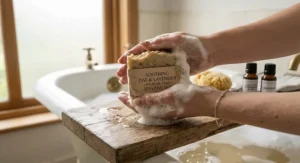
6. HERBOGANIC Castor Oil Herbal Soap — best castor-oil pick for extra-dry patches
Castor oil is the headline ingredient, and it’s worth explaining why that’s genuinely useful rather than just a novelty. Castor oil is unusually rich in ricinoleic acid, a fatty acid credited with strong emollient and mild anti-inflammatory properties, which is why it turns up so often in soap recipes aimed at very dry or flaky skin. Soap-makers often blend a small proportion of castor oil into a base recipe specifically to boost lather and add a silkier after-feel — this bar leans into that further than most.
What the spec sheet won’t tell you, but soap-making circles note, is that castor oil is typically used as a supporting ingredient (10-20% of a recipe) rather than the sole oil, because too much can leave a bar feeling tacky. A castor-oil-forward bar like this one tends to suit people managing rough patches on elbows, knees or heels more than all-over daily sensitive-skin washing, where a lighter olive or coconut oil bar might feel more comfortable. Reviewers frequently describe the bar as “rejuvenating” for very dry skin, with a noticeably rich, almost balm-like lather compared with standard bars.
Pros:
- ✅ Ricinoleic acid content targets very dry, rough patches
- ✅ Rich, cushioned lather unusual for a bar soap
- ✅ Works well as a targeted spot-treatment bar
Cons:
- ❌ Can feel slightly tacky if used at full strength daily
- ❌ Less suited to oily or combination skin types
Priced in the mid-£5 to £7 range depending on pack size, this is best valued as a targeted tool rather than an everyday all-over soap — buy it to solve a specific dry-patch problem, not to replace your main bar entirely.
7. Kiss My Face Pure Olive Oil Soap — simplest ingredient list on the market
Three ingredients: olive oil, water, and lye (which fully saponifies into soap, leaving no residual causticity). That’s the entire formulation, and for anyone doing serious ingredient elimination — whether for suspected allergies, eczema, or general caution — that simplicity is the single biggest selling point on this list. Based on the spec comparison with every other bar here, nothing else even comes close on minimalism.
Despite being almost entirely olive oil, aggregated reviews consistently note that it doesn’t leave a greasy residue, which surprises people expecting an oily film from a soap this concentrated in one oil. Reviewers managing palm oil intolerance and sensitivity specifically call this bar out as one of the few that reliably causes no reaction, and several mention it lasting for months of regular use — a genuine advantage over softer, faster-dissolving bars, provided it’s kept on a draining dish between washes.
Pros:
- ✅ Only three ingredients — minimal allergen exposure
- ✅ Long-lasting, dense bar that resists dissolving
- ✅ Strong track record with palm-sensitive users specifically
Cons:
- ❌ Very plain, no added scent or texture
- ❌ Denser bar takes slightly longer to work up a lather
At a mid-£4 to £6 price range, this bar’s value proposition is durability plus safety margin — a longer-lasting bar with the shortest possible ingredient list to go wrong.
Practical Usage Guide: Getting the Most From a Palm-Free Bar
Switching to a palm oil free soap for sensitive skin isn’t just a swap-and-forget decision — a few habits make a real difference to both how long the bar lasts and how your skin responds. First 30 days: use the bar on one small area (inner forearm) for two to three days before going all-in, especially if you’re managing eczema or a known sensitivity. This isn’t overcautious; it’s standard patch-testing practice recommended by dermatology services, since even “natural” ingredients like essential oils can trigger reactions in some people.
A common mistake is leaving the bar sitting in a pool of water between uses — palm-free bars, particularly olive-oil-forward ones like the Little Soap Company Unperfumed Pure Olive Oil Soap Bar, are softer than palm-oil bars and dissolve faster if not drained properly. A ridged soap dish or a simple wooden soap deck extends bar life noticeably, often by several weeks. Store spare bars somewhere dry and well-ventilated rather than sealed in plastic, since natural soaps without synthetic preservatives can occasionally develop a slightly different scent if kept in damp, airless conditions.
Optimisation tip: cut a large bar in half and keep one half wrapped away from moisture. You’ll extend the useful life of premium bars like the Save Our Seas Handmade Herbal Soap considerably, since only the half in active use is exposed to water and softening.
Real-World Scenarios: Who Should Buy Which Bar
Picture three quite different households, all searching for the same thing. First, a university student on a tight budget with mildly reactive skin, showering daily in shared accommodation — the Friendly Soap Lavender & Geranium Bar fits neatly here, combining a low price with a genuinely short, low-risk ingredient list, so a bad reaction doesn’t also mean wasted money.
Second, a parent of a toddler with diagnosed eczema, currently managing flare-ups with prescribed emollients but needing a soap that won’t undo that work in the bath. Here, the Little Soap Company Pure Organic Bar Soap or the All Natural Soap Co Honey & Oatmeal Soap both make sense, depending on whether the skin is currently intact (oatmeal bar, for the itch relief) or actively broken (organic fragrance-free bar, to avoid any textured exfoliation on compromised skin).
Third, a professional in their thirties dealing with persistently dry hands and elbows from frequent handwashing, who’s willing to spend more for visible results. The HERBOGANIC Castor Oil Herbal Soap used as a targeted hand and elbow bar, alongside a gentler all-over soap like Kiss My Face Pure Olive Oil Soap, covers both the spot-treatment and everyday-wash needs without over-complicating the routine.
What Is Palm Oil Free Soap?
Palm oil free soap is soap made without palm oil, palm kernel oil, or their common derivatives such as sodium palmate — typically substituting oils like olive, coconut, castor or shea butter instead. It’s chosen either to avoid a suspected skin sensitivity to palm derivatives, or for environmental reasons linked to palm oil farming.
That second point deserves unpacking, because it directly affects which soap is genuinely worth choosing. According to WWF-UK’s overview of palm oil’s environmental impact, unsustainable palm oil farming remains a leading cause of tropical deforestation, pushing species like orangutans and Sumatran rhinos out of their habitat while releasing stored carbon from cleared peatland. That’s the environmental case for going palm-free; the skin-sensitivity case is separate and personal, but the two often push buyers in the same direction.
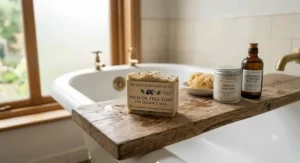
How to Choose Palm Oil Free Soap for Sensitive Skin
- Check for “sodium palmate” or “elaeis guineensis” on the label — these are palm oil’s saponified and Latin names respectively, and both hide in plenty of “natural” soap.
- Prioritise short ingredient lists — fewer ingredients means fewer possible triggers, particularly important during an active flare-up.
- Look for fragrance-free over “unscented” — the latter sometimes means a masking fragrance has been added to cancel out other scents, which defeats the purpose.
- Match the oil profile to your skin’s actual problem — olive oil for dryness and tightness, oatmeal or honey for itch, castor oil for rough patches.
- Check the pH where listed — traditional cold-process soap sits slightly alkaline (around pH 9-10), which can be an issue for very reactive skin compared with syndet (soap-free) bars.
- Read aggregated reviews for sensitivity mentions specifically — a bar with generally good reviews can still be a poor fit if nobody with reactive skin has weighed in.
- Buy the smallest size first — even a well-researched choice is still a personal experiment; a full-size multipack is a false economy if the first wash doesn’t agree with you.
Palm Free Soap for Eczema: What Actually Helps
Eczema-prone skin has a compromised barrier, which means it loses moisture faster and lets irritants in more easily than typical skin — soap choice genuinely matters here, not just as a comfort preference. NHS Inform’s guidance on atopic eczema recommends avoiding soaps and detergents that irritate the skin and keeping up regular emollient use even when symptoms improve. That’s a strong signal that “which soap” is a legitimate clinical consideration, not just a lifestyle choice.
Among the seven bars covered here, the Little Soap Company Pure Organic Bar Soap and the All Natural Soap Co Honey & Oatmeal Soap are the strongest eczema-adjacent picks — the former for its stripped-back, fragrance-free formulation suited to active flare-ups, the latter for its soothing oatmeal content once skin is intact but still itchy. Reviewers managing eczema consistently flag both as gentler than standard high-street soap, though as with any eczema-related product, patch testing on unaffected skin first remains the sensible approach rather than testing directly on a flare.
Gentle Palm Oil Free Bar Soap: What “Gentle” Actually Means on a Label
“Gentle” is one of the most overused words in skincare marketing, and it’s worth being sceptical of it as a standalone claim. What actually makes a bar gentle is a combination of factors: a soap superfatted with extra oil (meaning slightly more oil than the lye can saponify, leaving a moisturising residue), the absence of synthetic fragrance and colourants, and a lower proportion of coconut oil relative to more cushioning oils like olive or shea, since coconut oil is a stronger cleanser and can be more stripping in high concentrations.
Common mistakes when buying “gentle” soap include assuming any handmade or artisan bar is automatically mild — some small-batch soaps are actually formulated with high coconut oil content for maximum lather, which can be the opposite of gentle for reactive skin. The safest approach is to check the oil order on the ingredients list; oils are typically listed by concentration, so a bar listing coconut oil first and olive oil third is a different beast to one listing olive oil first.
Olive Oil vs Coconut Oil vs Castor Oil Soap Bars: Full Comparison
| Oil Type | Feel on Skin | Lather | Best Match |
|---|---|---|---|
| Olive oil (e.g. Little Soap Company Unperfumed Pure Olive Oil Soap Bar) | Cushioned, moisturising | Dense, slow-building | Dry, tight, reactive skin |
| Coconut oil (e.g. All Natural Soap Co Honey & Oatmeal Soap) | Fresh, cleansing | Big, bubbly lather | Normal to oily skin, everyday washing |
| Castor oil (e.g. HERBOGANIC Castor Oil Herbal Soap) | Rich, almost balm-like | Creamy, cushioned | Rough patches, targeted dry spots |
The written comparison matters more than the table alone: coconut oil is a stronger cleanser and produces more lather because its fatty acid profile (mostly lauric acid) is efficient at lifting oil and dirt, but that same efficiency can strip natural oils from already-compromised skin. Olive oil sits at the opposite end, prized for cushioning rather than cleansing power, which explains why so many “sensitive skin” bars lean heavily on it. Castor oil rarely stands alone in soap-making — it’s usually a supporting player precisely because its rich, humectant qualities work best in smaller doses layered alongside a primary oil.
Common Mistakes When Buying Palm Oil Free Soap
The most frequent misstep is assuming “natural” automatically means palm-free — many soaps marketed with leaf-and-flower branding still list sodium palmate a few ingredients down. A second common error is switching an entire household to a new bar simultaneously rather than patch-testing individually, since sensitivity varies significantly even between family members with similar skin types. A third mistake is judging a bar purely on scent appeal in-store; a lovely fragrance says nothing about whether the underlying oil blend suits reactive skin.
Buyers also frequently overlook bar hardness and storage, buying a soft, generously superfatted bar and then leaving it to dissolve in a puddle within a fortnight — a false economy that makes premium bars like the Save Our Seas Handmade Herbal Soap seem overpriced when the real issue is storage, not formulation. Finally, some shoppers assume a higher price automatically means a better fit for sensitive skin, when in reality a simple three-ingredient bar like Kiss My Face Pure Olive Oil Soap can outperform a pricier multi-oil blend for genuinely reactive skin.
Features That Actually Matter (And Those That Don’t)
Ingredient count and oil order matter enormously; scent, colour and shape do not, beyond personal preference. A soap doesn’t need to be a particular colour or texture to be effective — those are cosmetic choices layered on top of the actual formulation. Superfatting level matters (a higher superfat generally means a gentler, more moisturising bar) but it’s rarely printed clearly on UK packaging, so cross-referencing brand websites or contacting the seller directly is often necessary to find it.
What doesn’t matter nearly as much as marketing suggests: “handmade” as a standalone claim, since a poorly formulated handmade bar can be harsher than a well-formulated mass-produced one. Similarly, “artisan” or “small-batch” labelling says nothing about suitability for sensitive skin on its own — it’s a production-method claim, not a formulation claim, and shouldn’t be mistaken for one.
Long-Term Cost & Maintenance: Working Out Real Value
A bar soap’s true cost-per-wash depends heavily on hardness and storage, which is why headline price alone is misleading. A softer, highly superfatted bar like the Little Soap Company Unperfumed Pure Olive Oil Soap Bar may cost less upfront than the Save Our Seas Handmade Herbal Soap, but if it dissolves twice as fast without a draining dish, the actual cost-per-wash gap narrows considerably.
Total cost of ownership also includes what you’re not spending — if switching away from palm oil resolves ongoing irritation, the savings on moisturiser, anti-itch creams or even GP visits for flare-ups can dwarf the soap price difference entirely. Buyers managing eczema in particular should weigh a slightly pricier bar like the All Natural Soap Co Honey & Oatmeal Soap against the cumulative cost of managing untreated irritation, rather than comparing soap prices in isolation.
Safety, Sustainability and UK Regulations
All cosmetic soap sold in Great Britain must be notified through the correct safety framework before it reaches shelves. Per gov.uk’s data on UK cosmetic product safety notifications, any business placing a cosmetic on the GB market must register it through the Submit Cosmetic Product Notification system via a UK-based Responsible Person, with hundreds of thousands of products logged this way to date. In practice, this means any legitimately sold soap bar — including every product on this list — has passed a formal safety and traceability check, even if the ingredients themselves still occasionally disagree with a particular person’s skin.
On the sustainability side, choosing palm-free isn’t the only ethical option — WWF’s guidance on sustainable palm oil points out that backing RSPO-certified sustainable palm oil is often a more effective way to protect rainforest habitat than a blanket boycott, since swapping to other vegetable oils can simply push the environmental pressure elsewhere. For skin-sensitivity-driven buyers, though, that’s a separate conversation from an outright allergy or irritation concern, where avoiding palm derivatives entirely remains the sensible priority regardless of certification status.
Buyer’s Decision Framework
If you’re managing an active eczema flare, choose a fragrance-free, minimal-ingredient bar like the Little Soap Company Pure Organic Bar Soap, because reducing variables matters more than added benefits while skin is compromised. If your skin is simply dry and tight rather than actively irritated, an olive-oil-forward bar such as Kiss My Face Pure Olive Oil Soap or the Little Soap Company Unperfumed Pure Olive Oil Soap Bar should be your starting point.
If you’re dealing with specific rough patches — elbows, heels, knees — layer in a targeted castor-oil bar like the HERBOGANIC Castor Oil Herbal Soap alongside your everyday wash rather than replacing it outright. And if budget is the primary constraint, start with the Friendly Soap Lavender & Geranium Bar; its low cost makes it a sensible first experiment even if you later graduate to a pricier option.
✨ Ready to make the switch? Explore the full range of gentle, palm-free bars above and find the one that matches your skin’s specific needs.
Frequently Asked Questions
❓ Is palm oil free soap better for sensitive skin?
❓ What ingredients should I avoid if I have eczema?
❓ Does coconut oil soap dry out sensitive skin?
❓ How long does a natural bar of soap last?
❓ Is castor oil soap good for dry skin?
Recommended for You
- Palm Oil Free Soap Bar: 7 Best Picks for 2026 (UK Guide)
- Best Ethical Soap Bars 2026: 7 Cruelty-Free Picks That Deliver
- Cruelty Free Soap for Sensitive Skin: 7 Best UK Picks 2026
Disclaimer: This article contains affiliate links. As an Amazon Associate, I earn from qualifying purchases. If you purchase products through these links, we may earn a small commission at no additional cost to you.
✨ Found this helpful? Share it with your friends! 💬🤗
