In This Article
What is syndet bar vs traditional soap for rosacea, really? A syndet bar is a solid cleanser made from synthetic detergents (surfactants) and tuned to a skin-friendlier pH. Traditional soap is fat reacted with alkali, which leaves it strongly alkaline. For a face that flushes, stings and reacts to almost everything, that difference is not trivial.
Here’s the awkward truth. Most of us were raised on the humble bar of soap, and it feels virtuous: squeaky, clean, no-nonsense. But rosacea skin doesn’t want squeaky. It wants calm. The British Association of Dermatologists’ rosacea leaflet advises against rubbing or scrubbing the face, against perfumed soap, and in favour of a soap substitute (emollient) for cleansing. That is a polite way of saying the bar you grew up with may be part of the problem.
So I’ve done the legwork. This guide compares the chemistry, then walks through seven real bars worth considering, from budget to premium, with honest notes on fragrance, formulation quirks and who each suits. A caveat up front: I haven’t tested these bars myself, and I couldn’t verify aggregated Amazon review scores, so I won’t quote star ratings. Everything below is built from product specifications, ingredient lists and published guidance.
Quick Comparison: 7 Syndet Bars for Rosacea-Prone Skin at a Glance
| Product | Format | Headline claim | Fragrance flag | Price range | Best For |
|---|---|---|---|---|---|
| Sebamed Cleansing Bar | 100-150 g | pH 5.5, soap-free | Contains parfum | Under £10 | Acid-balanced everyday washing |
| Dove Sensitive Beauty Cream Bar | Multipacks | Syndet, near-neutral pH | Fragrance-free | Under £10 | Budget-friendly simplicity |
| Avène Cold Cream Ultra-Rich Cleansing Bar | 100 g | Soap-free, skin-matched pH | Check the pack | Under £15 | Dry, tight-feeling skin |
| La Roche-Posay Lipikar Surgras Cleansing Bar | 150 g | Niacinamide, shea, anti-hard-water agents | Contains parfum | Under £15 | Hard-water postcodes (with a caveat) |
| Bioderma Atoderm Intensive Pain | 150 g | Niacinamide, fragrance-free | Fragrance-free | Under £15 | Very dry, easily irritated skin |
| Cetaphil Gentle Cleansing Bar | 127 g | Soap-free, pH-balanced | Fragrance-free per some listings | Under £10 | Minimalists |
| Avril Dermatological Syndet Bar | 68 g | pH-neutral, soap-free | Subtle scent | Under £10 | Eco-minded shoppers |
Looking at the table, the Dove Sensitive Beauty Cream Bar and Cetaphil Gentle Cleansing Bar are the simplest, fragrance-free routes. Sebamed Cleansing Bar has the most skin-like pH claim but includes perfume, which matters for reactive faces. Bioderma Atoderm Intensive Pain and Avène Cold Cream Ultra-Rich Cleansing Bar lean richer, so they suit dry rosacea better than oily, bumpy rosacea. Prices are indicative ranges only and change often, so check current prices on amazon.co.uk before buying.
💬 Just one click: help others make better buying decisions too! 😊
Top 7 Syndet Bars for Rosacea-Prone Skin: Expert Analysis
Every bar below is assessed on the same questions. What does the surfactant system suggest about mildness? Is there fragrance? What does it leave behind on the skin? Availability on amazon.co.uk varies by seller and over time, so confirm the listing and the ingredient list on the pack before you buy, because formulations differ between markets.
1. Sebamed Cleansing Bar — closest match to skin’s own acidity
Sebamed Cleansing Bar built its reputation on a pH of 5.5, a figure the brand pitches as matching healthy skin. It is sold as soap-free and alkali-free.
The surfactant blend is layered: disodium lauryl sulfosuccinate, sodium lauroyl sarcosinate, cocamidopropyl betaine and sodium cocoyl glutamate, plus panthenol, lecithin and amino acids. In practice, blending several gentle cleansers rather than leaning on one strong workhorse is a common mildness strategy. The catch for rosacea is that the ingredient list also includes fragrance and colourants.
My honest read: Sebamed Cleansing Bar suits mild-to-moderate sensitivity, especially if your skin is normal or combination and you want a firmly acid-balanced wash. If perfume makes your face burn, patch test on the jawline first, or choose a fragrance-free rival below.
On reviews, I couldn’t verify aggregate scores. The few retailer comments I could find were single anecdotes, such as a shopper returning to the bar after other cleansers irritated her skin. Treat that as colour, not evidence.
Pros:
- ✅ Acid-balanced pH 5.5 positioning
- ✅ Layered mild surfactant blend
- ✅ Face and body versatility
Cons:
- ❌ Contains fragrance, a risk for reactive faces
- ❌ Includes colourants you don’t need
Price: roughly under £10; check current price. Value verdict: strong for a classic, provided your skin tolerates fragrance.

2. Dove Sensitive Beauty Cream Bar — cheap, proven syndet base
The headline feature of the Dove Sensitive Beauty Cream Bar is that it isn’t technically soap at all. Its lead surfactant is sodium lauroyl isethionate, a classic syndet ingredient, in a fragrance-free, hypoallergenic format.
Dove describes the formula as mild and pH-neutral, and a skin-science reference puts it at roughly pH 7. That is far kinder than soap’s pH 9-10, though still above the acid mantle’s usual 4.5-5.5. Notably, the Dove Sensitive Skin bar was used in the rosacea trial discussed in a 2017 dermatology supplement, so there’s a research trail behind it. Packaging names differ by country, so check you’ve got the sensitive, fragrance-free variant.
The honest take: this is the sensible starting point if you’re moving off traditional soap on a budget. The “quarter moisturising cream” claim is marketing shorthand for emollient content, which helps you avoid that tight, post-wash feeling.
Reviewer sentiment: I couldn’t verify aggregated Amazon scores. Online discussion of Dove generally focuses on its mildness compared with ordinary soap, but that’s anecdotal.
Pros:
- ✅ Fragrance-free, hypoallergenic positioning
- ✅ Syndet base with research exposure
- ✅ Inexpensive and widely stocked
Cons:
- ❌ Near-neutral pH, not acidic
- ❌ Can feel emollient on oilier skin
Price: well under £10 even in multipacks; check current price. Value verdict: the best entry point.
3. Avène Cold Cream Ultra-Rich Cleansing Bar — comfort-first for tight skin
Avène Cold Cream Ultra-Rich Cleansing Bar is the comfort-first option, built for dry to very dry sensitive skin. It is described as soap-free, lanolin-free, hypoallergenic and non-comedogenic, with a pH adapted to skin and Avène thermal spring water.
The ultra-rich label signals more emollient left behind, which can be a blessing in winter or when topical treatments are drying you out. It also means the bar can feel heavy for people whose rosacea comes with oiliness or breakouts. Suitability for children and infants, per the brand, is a reassuring marker of tolerance.
Who is it for? Dry, flushing, tight-feeling skin that complains after every wash. The one review snippet I could verify, from a marketplace listing, praised it as less harsh than other soaps and kind to sensitive skin. That is a single voice, not a consensus.
Check the ingredient list on the pack for fragrance before buying, as I couldn’t confirm that from the sources I reviewed.
Pros:
- ✅ Soap-free, skin-matched pH positioning
- ✅ Rich feel suits dry, tight skin
- ✅ Gentle enough for family use
Cons:
- ❌ Too rich for oily or bumpy rosacea
- ❌ Fragrance status needs checking
Price: under £15 range; check current price. Value verdict: worthwhile if dryness is your main enemy.
4. La Roche-Posay Lipikar Surgras Cleansing Bar — hard-water fighter with a label twist
The standout on La Roche-Posay Lipikar Surgras Cleansing Bar is its attention to hard water. The formula includes chelating agents, and a UK retailer describes them as preventing dryness and irritation from hard water, which matters across much of southern and eastern England. It also features niacinamide, shea butter and glycerine.
Here’s the twist. One UK retailer listing sells it as soap-free, yet the ingredient list opens with sodium palmate and sodium palm kernelate, which are generally recognised as traditional soap salts. That would make it more of a combination bar than a pure syndet. Formulations change, so read your pack and ask a pharmacist if in doubt. The list also includes fragrance.
My take: the shea and niacinamide profile is appealing for dry, eczema-prone skin. But for rosacea, the potential soap content plus perfume makes it a more cautious pick than Bioderma Atoderm Intensive Pain or Dove Sensitive Beauty Cream Bar.
I couldn’t verify aggregated review data for this bar.
Pros:
- ✅ Hard-water-conscious formulation
- ✅ Niacinamide and shea butter for comfort
- ✅ Family-friendly positioning
Cons:
- ❌ Ingredient list suggests soap components
- ❌ Contains fragrance
Price: under £15 range; check current price. Value verdict: decent for dry skin, riskier for rosacea.
5. Bioderma Atoderm Intensive Pain — fragrance-free and built for very dry skin
Bioderma Atoderm Intensive Pain is the fragrance-free heavyweight for very dry, irritated skin. The brand describes it as soap-free, with niacinamide, shea oil and a patented complex it says boosts the skin’s tolerance threshold.
The ingredient list shows a sulfate-based system (sodium laureth sulfate) paired with lauryl glucoside, plus zinc and copper sulfate and several skin-identical moisturisers. Sulfates in a rinse-off bar are not automatically a villain, but some rosacea sufferers prefer to avoid them, so tolerance is individual. The brand states a skin-identical pH without giving a number in the listings I saw.
The analytical take: this is the bar for dry, reactive, eczema-prone skin that also has rosacea tendencies. It’s less obviously suited to oily, papulopustular rosacea, where a lighter bar will feel better. The no-fragrance formula is a genuine advantage over Sebamed Cleansing Bar and La Roche-Posay Lipikar Surgras Cleansing Bar.
Review sentiment: I couldn’t verify aggregated scores.
Pros:
- ✅ Fragrance-free formulation
- ✅ Niacinamide and shea oil for barrier comfort
- ✅ Suits very dry, irritated skin
Cons:
- ❌ Sulfate-based system divides opinion
- ❌ Richness may not suit oily skin
Price: under £15 range; check current price. Value verdict: fair for the fragrance-free, rich-bar niche.

6. Cetaphil Gentle Cleansing Bar — minimalist, heavily dermatologist-marketed
Cetaphil Gentle Cleansing Bar is the minimalist option: a soap-free, pH-balanced, hypoallergenic bar for face and body, described as fragrance-free in some listings.
Formulations vary by market. One overseas pharmacy listing named sodium cocoyl isethionate alongside sodium tallowate and sodium stearate, which suggests a combination base. UK stock has also been less clear than for Cetaphil’s liquid products, and I couldn’t confirm availability, so check the listing and pack before planning around it.
There’s a useful research angle, too. In the randomised comparison discussed in the dermatology supplement, the Cetaphil Gentle Skin Cleanser (a liquid) outperformed a syndet bar on measured outcomes, and patients preferred it. Bars aren’t automatically better than liquids, and this brand’s best-evidenced product is a liquid, not this bar.
Who’s it for? Shoppers who want a simple, widely recognised name and don’t want perfume. I couldn’t verify aggregated reviews.
Pros:
- ✅ Fragrance-free per several listings
- ✅ Face and body versatility
- ✅ Familiar, dermatologist-marketed brand
Cons:
- ❌ Formulation varies by market
- ❌ UK availability needs checking
Price: roughly under £10; check current price. Value verdict: good if stocked and the label checks out.
7. Avril Dermatological Syndet Bar — compact, eco-minded and pH-neutral
Avril Dermatological Syndet Bar is the compact, eco-minded pick: a 68 g bar described as soap-free, pH-neutral, vegan and plastic-free, for face and body. It is formulated and tested for children from age three.
Organic almond oil gives it a nourishing touch, but the retailer also mentions a subtle scent, which is the main flag for rosacea. Smaller size means shorter life per bar, which affects value (see the cost section). It is typically sold by specialist natural-beauty shops, so check amazon.co.uk for third-party listings.
The verdict: a sensible syndet for people who value sustainability and a gentle, simple surfactant approach, but fragrance-sensitive faces should patch test. The one retailer review I saw was a single data point, so I can’t offer review sentiment.
Pros:
- ✅ Soap-free, pH-neutral syndet positioning
- ✅ Plastic-free, vegan credentials
- ✅ Nourishing almond oil
Cons:
- ❌ Subtle scent may bother reactive faces
- ❌ Small bar wears down quickly
Price: under £10 range; check current price. Value verdict: pleasant but pricier per gram than mainstream rivals.
Specs Compared: What the Numbers Mean for Rosacea
| Product | Stated pH | Soap-free claim | Fragrance | Key extras | Best For |
|---|---|---|---|---|---|
| Sebamed Cleansing Bar | 5.5 | Yes | Yes | Panthenol, lecithin | Acidic-pH seekers |
| Dove Sensitive Beauty Cream Bar | Near-neutral | Syndet | No | Moisturising cream | Budget starters |
| Avène Cold Cream Ultra-Rich Cleansing Bar | Skin-adapted | Yes | Check pack | Thermal water | Dry skin |
| La Roche-Posay Lipikar Surgras Cleansing Bar | Not stated | Claimed, label shows soap salts | Yes | Niacinamide, shea | Hard water, dryness |
| Bioderma Atoderm Intensive Pain | Skin-identical | Yes | No | Niacinamide, shea oil | Very dry skin |
| Cetaphil Gentle Cleansing Bar | Balanced | Yes | No (per listings) | Emollient blend | Simplicity |
| Avril Dermatological Syndet Bar | Neutral | Yes | Subtle scent | Almond oil | Eco-minded buyers |
The pattern is clear: fragrance is the differentiator that matters most for rosacea, ahead of the pH number. Bioderma Atoderm Intensive Pain, Dove Sensitive Beauty Cream Bar and Cetaphil Gentle Cleansing Bar are the fragrance-free picks. Sebamed Cleansing Bar wins on pH but loses on perfume. La Roche-Posay Lipikar Surgras Cleansing Bar is the one where reading the label matters most.
Syndet Bar vs Traditional Soap for Rosacea: What Actually Differs?
The core of syndet bar vs traditional soap for rosacea is chemistry. Traditional soap forms when fats react with alkali, producing soap salts that lather brilliantly and rinse leaving an alkaline film. Syndet bars swap those salts for synthetic surfactants such as isethionates and sarcosinates, chosen for gentleness and pH control.
A dermatology-industry source describes soap-based cleansers as causing barrier disruption, lipid dissolution and pH alteration. That matters because rosacea skin already has a compromised barrier. A syndet bar is the same format with fewer drawbacks.
| Factor | Traditional soap | Syndet bar |
|---|---|---|
| Typical pH | Around 9-10 | Roughly 5.5-7 |
| Main cleanser | Saponified fats | Synthetic surfactants |
| Barrier impact | Can strip lipids | Generally gentler |
| Hard-water behaviour | Can leave scum | Usually rinses cleaner |
| Best For | Hands, non-reactive skin | Rosacea-prone faces |
The takeaway: for syndet bar vs traditional soap for rosacea, the syndet wins on mildness and predictability, though “syndet” isn’t a guarantee. A harsh syndet can still irritate, and some combination bars blur the line. Choose on the whole formula, not the label.
Skin pH and Alkaline Soap Irritation: What Happens on a Rosacea-Prone Face
Why skin pH matters
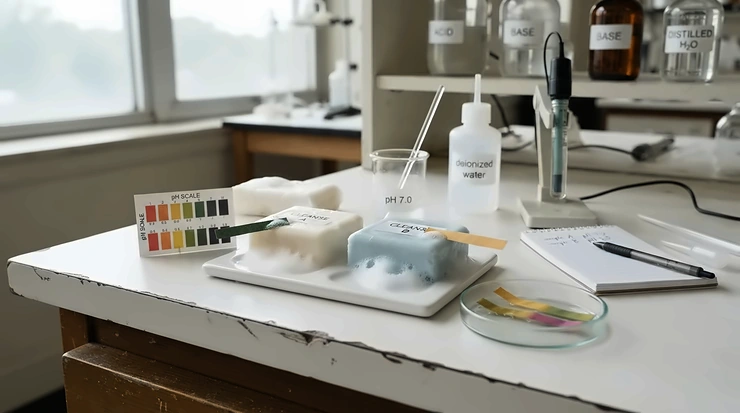
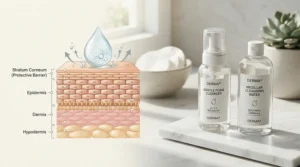
Healthy skin is mildly acidic, usually quoted at roughly 4.5-5.5. That acid mantle supports barrier enzymes and the skin’s microbial balance. Raise skin pH sharply and the barrier takes time to recover, during which rosacea-prone skin can sting, tighten and flush.
Alkaline soap irritation in practice
Alkaline soap irritation is a double hit. High pH is one problem, but soap’s lipid-stripping action is another. The NHS Wales rosacea page lists a burning or stinging feeling when using water or skincare products as an early sign, so a cleanser that strips the barrier can hit a face that’s already primed to react.
Don’t over-worship the number
Here’s the nuance most marketing skips. A pH-balanced cleansing bar for face is a good start, but surfactant mildness, fragrance and rinse-off residue matter just as much. A pH 5.5 bar with perfume can irritate more than a pH 7 fragrance-free bar. Treat skin pH as one clue, not the verdict.
Decoding the Labels: Soap-Free, pH-Balanced and Synthetic Detergent Bars
Marketing language is slippery. A soap-free cleansing bar means no traditional saponified soap in theory, but as the La Roche-Posay Lipikar Surgras Cleansing Bar example shows, you should check the ingredients. Look for sodium palmate, sodium tallowate, sodium cocoate or sodium stearate; those are soap-type salts.
A pH-balanced cleansing bar for face should state a pH or a skin-friendly range, not just the phrase. Synthetic detergent bars, often called syndets, use surfactants such as sodium cocoyl isethionate, sodium lauroyl isethionate or sulfosuccinates. Combination bars blend both worlds.
The practical rule: scan the first five ingredients. If you see a surfactant name you recognise as synthetic and no soap salts near the top, you’re looking at a genuine syndet. If you see both, it’s a combination bar, which may still be fine but is less predictable for rosacea.
How to Choose a Syndet Bar for Rosacea (5-7 Steps)
- Check for fragrance first. The BAD leaflet advises avoiding perfumed soap, and perfume is among the most common cosmetic irritants.
- Read the first five ingredients. Look for isethionates, sulfosuccinates or glutamates, not sodium palmate or tallowate.
- Match richness to your rosacea type. Dry, tight skin suits richer bars; oily or bumpy skin suits lighter ones.
- Look for a stated pH. A figure between roughly 5.5 and 7 beats a vague “balanced” claim.
- Avoid physical exfoliants. Scrubby particles contradict the don’t-rub advice.
- Check your water. If you live in a hard-water area, a bar with chelating agents may rinse better.
- Patch test. Try a small area for a few days before committing your whole face.
Common Mistakes When Buying a Syndet Bar for Rosacea
Mistake one: trusting “natural” as a safety signal. Essential oils and botanical fragrances are common rosacea irritants, so “natural” can mean riskier.
Mistake two: buying on pH alone. As covered, pH is only one variable.
Mistake three: scrubbing harder. Even the mildest bar fails if you rub; lather in your hands, apply gently and rinse.
Mistake four: hot water. Heat is a classic trigger. Lukewarm is the sweet spot.
Mistake five: expecting a bar to treat rosacea. A cleanser reduces irritation; it doesn’t treat the condition. If your symptoms persist, see your GP.
Practical Usage Guide: Your First 30 Days with a Syndet Bar
Days 1-3: patch test. Wash a small area, such as along the jaw, once a day. Watch for stinging or new redness.
Days 4-10: switch fully. Use the bar morning and evening, or just evening if your skin is dry. Lather in wet hands, not directly on the face, and rinse with lukewarm water. Pat dry, never rub.
Days 11-20: observe and adjust. If tightness appears, add a suitable emollient straight after washing, and consider washing only at night.
Days 21-30: review. Keep a diary of flares, as the BAD leaflet suggests. If nothing improves, or things worsen, stop and speak to a pharmacist or GP.
Bar care: let the bar dry between uses on a draining soap dish, because a mushy bar wears down quickly and harbours more mess. Keep a separate bar for your face if you share a shower.

Real-World Scenarios: Matching Bars to Buyer Profiles
Scenario one: the budget-conscious student. You’re on a tight budget, have mild facial flushing and live in halls with hard water. The Dove Sensitive Beauty Cream Bar is the obvious starting point: cheap, fragrance-free and syndet-based. Use it once or twice daily.
Scenario two: the 55-year-old with dry, tight, persistently red cheeks. Your skin feels like cling film after washing. The Avène Cold Cream Ultra-Rich Cleansing Bar or Bioderma Atoderm Intensive Pain offers richer comfort. Use it evenings and rinse with cool-to-lukewarm water.
Scenario three: the minimalist traveller with oily, bumpy rosacea. A rich bar will feel heavy. The Cetaphil Gentle Cleansing Bar, if stocked, or the Dove Sensitive Beauty Cream Bar offers a lighter touch. Travel bars need a ventilated case to dry between uses.
Across all three, frequency, environment and budget shape the choice more than brand loyalty.
Problem and Solution Guide: When Your Bar Isn’t Working
Problem: stinging on application. Likely cause: fragrance or an ingredient sensitivity. Solution: switch to a fragrance-free bar such as Bioderma Atoderm Intensive Pain, and shorten lathering time.
Problem: tightness after rinsing. Likely cause: bar too light, or water too hot. Solution: cool the water and consider a richer option like Avène Cold Cream Ultra-Rich Cleansing Bar.
Problem: new bumps. Likely cause: a heavy bar clogging oilier skin. Solution: try a lighter formulation and ask your pharmacist about it.
Problem: no improvement at all. The Primary Care Dermatology Society leaflet is blunt that rosacea isn’t caused by poor hygiene, and cleansers alone don’t resolve it. Solution: speak to your GP about treatment.
Long-Term Cost and Maintenance: Which Bar Is Cheapest Per Wash?
Bars are economical, but not equally so. Bar weight and how quickly it dissolves determine cost per use. A bigger 150 g bar like Bioderma Atoderm Intensive Pain or La Roche-Posay Lipikar Surgras Cleansing Bar typically lasts longer than the compact Avril Dermatological Syndet Bar at 68 g.
| Product | Size | Price band | Cost-per-use logic | Best For |
|---|---|---|---|---|
| Dove Sensitive Beauty Cream Bar | Multipack | Under £10 | Lowest cost per bar | Tight budgets |
| Sebamed Cleansing Bar | 100-150 g | Under £10 | Mid cost per use | Everyday value |
| Bioderma Atoderm Intensive Pain | 150 g | Under £15 | Large bar, long life | Heavy users |
| Avril Dermatological Syndet Bar | 68 g | Under £10 | Small bar, pricier per gram | Sustainability fans |
The maths favours big bars and multipacks, as long as you keep them dry between washes. Saving a few pounds matters less than avoiding a flare that costs you a week of discomfort, so don’t sacrifice fragrance-free for a discount.
Syndet Bar vs Liquid Cleanser: Is a Bar Even Necessary?
Honest answer: not always. In the randomised study discussed in the dermatology supplement, rosacea patients using a lipid-free liquid cleanser did better than those using a syndet bar on measured outcomes, and they preferred it. I’d treat that as a reminder that formats aren’t magic.
Bars have advantages: less packaging, longer life and simpler formulations. Liquids are easier to apply without rubbing and can feel gentler on the very sensitive. If a syndet bar leaves you tight or stingy, try a gentle liquid cleanser before concluding that cleansing is the problem.
Safety and Guidance: When to See a GP or Pharmacist
Cleansers are not treatments. The NHS Wales rosacea page explains that rosacea can’t be cured but a GP can help control symptoms, and that it isn’t caused by poor hygiene or contagious. If you experience eye symptoms, persistent bumps, thickening skin, or flushing that disrupts daily life, get medical advice.
Always patch test, stop use if burning develops, and don’t assume a “dermatologist-recommended” label replaces personal tolerance. This article is general information, not medical advice.

FAQ
❓ What is the best syndet bar for rosacea in the UK?
❓ Is a soap-free cleansing bar the same as a syndet bar?
❓ Can I use a pH-balanced cleansing bar for face and body?
❓ How often should I wash with a syndet bar if I have rosacea?
❓ Does alkaline soap irritation cause rosacea?
Conclusion
Syndet bar vs traditional soap for rosacea isn’t a close contest. Traditional soap’s alkalinity and lipid-stripping action work against a barrier that’s already struggling, while a well-chosen syndet bar cleans without the drama. Official guidance from UK dermatology bodies points the same direction: avoid perfumed soap, don’t scrub, and cleanse gently.
If you want my shortlist logic, start with fragrance-free and work outwards. The Dove Sensitive Beauty Cream Bar is the budget starter. Bioderma Atoderm Intensive Pain and Avène Cold Cream Ultra-Rich Cleansing Bar suit dry, tight skin. Cetaphil Gentle Cleansing Bar suits minimalists if you can find it. Sebamed Cleansing Bar has the most skin-like pH but includes fragrance. La Roche-Posay Lipikar Surgras Cleansing Bar demands label-reading, and Avril Dermatological Syndet Bar is the compact eco choice.
Whatever you pick, patch test, keep the water lukewarm, and keep a flare diary. A bar can calm one trigger, but your GP is the route to actual treatment.
Recommended for You
- Soap For Rosacea: 7 Best Gentle Picks For UK Skin (2026)
- Hypoallergenic Soap Bar For Kids: 7 Best Gentle Picks (2026)
- Hypoallergenic Soap For Sensitive Skin: 7 Best Trusted Bars (2026)
Disclaimer: This article contains affiliate links. As an Amazon Associate, I earn from qualifying purchases. If you purchase products through these links, we may earn a small commission at no additional cost to you.
✨ Found this helpful? Share it with your friends! 💬🤗
